
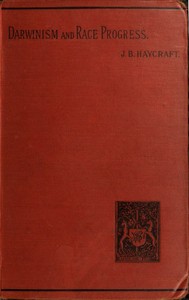
Darwinism and Race Progress by John Berry Haycraft
Published in 1895, John Berry Haycraft's Darwinism and Race Progress is a book that applies Charles Darwin's theory of natural selection directly to human societies. Haycraft, a physician and professor, argues that the 'struggle for existence' isn't just for animals; it's a constant battle between human races. He lays out a hierarchy, placing the 'white race' (specifically Anglo-Saxons) at the top as the most evolved and civilized. Other races are positioned lower on this invented ladder, described as less developed or even 'child-like.' The book's 'plot' is its argument: that this racial competition is natural and that interference (like providing aid or opposing colonialism) might hinder the 'progress' of the superior race. It's a manifesto for the social and political ideologies of its time, using scientific terms to justify empire and inequality.
Why You Should Read It
You don't read this book to agree with it. You read it to understand a dark chapter in intellectual history. It's a primary source that shows how easily science can be misused. Seeing terms like 'survival of the fittest' applied so confidently to justify racism is a chilling lesson. It makes you appreciate how far we've come in rejecting these ideas, but also how they shaped policies and prejudices that lasted for generations. Reading Haycraft's cold, clinical language about human worth is deeply unsettling, and that's the point. It forces you to confront the fact that these weren't just vague prejudices; they were presented as logical, biological facts by educated people.
Final Verdict
This book is not for casual enjoyment. It's for readers interested in the history of science, the history of racism, or the Victorian mindset. It's a tough but important read for students of history or sociology who want to see how pseudoscience was constructed. If you've ever wondered how people in the past could believe such terrible things, Haycraft provides a clear, ugly answer. Approach it as a historical document, not a guide, and be prepared for a stark reminder of why critical thinking matters so much.
Matthew Moore
1 year agoThe index links actually work, which is rare!





Amanda Garcia
2 years agoGood quality content.