
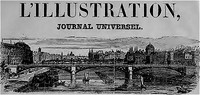
L'Illustration, No. 0038, 18 Novembre 1843 by Various
Let’s be clear from the start: this is not a book in the traditional sense. L'Illustration, No. 0038 is a single issue of what was essentially the world’s first fully illustrated weekly news magazine. Published in Paris on November 18, 1843, it’s a snapshot of a world in the throes of massive change, captured in real-time.
The Story
There’s no linear plot. Instead, you open the pages and are immediately immersed in the week’s events. The 'story' is the lived experience of November 1843. You’ll find a lengthy, illustrated feature on the construction of the Bordeaux railway bridge, complete with technical diagrams—a testament to industrial optimism. There are parliamentary reports that read like political gossip columns, and society pages detailing royal movements. Advertisements for patent medicines and new books sit alongside serialized fiction. The most striking elements are the woodcut and steel engravings: a dramatic scene of a storm in Algeria, dignified portraits of dignitaries, and fashion plates showing the elaborate, structured clothing of the era. It’s a chaotic, wonderful jumble of the serious and the frivolous, exactly like our modern news cycles, but with more elegant typography.
Why You Should Read It
I love this because it destroys the idea of the past as a monolith. This magazine shows a society that was just as complex and contradictory as ours. They were obsessed with technology (trains!), tangled in colonial misadventures (Algeria), entertained by fashion and scandal, and trying to make sense of a rapidly modernizing world. Reading it feels intimate. You’re not getting a historian’s polished summary; you’re getting the raw, unfiltered material they later use. The paper feels substantial, the ink has a slight texture, and the illustrations demand you slow down and look closely. It makes history feel less like a subject and more like a place you can visit.
Final Verdict
Perfect for history buffs who are tired of textbooks, for artists and designers fascinated by vintage print culture, and for any curious reader who enjoys primary sources. It’s not a page-turner in the thriller sense, but it is utterly gripping in its own way. You don’t read it cover-to-cover in one sitting. You dip in, explore an article, study an engraving, and let your imagination fill in the sounds and smells of that Parisian autumn. A unique and deeply rewarding experience for the patient and curious mind.




Patricia Lewis
10 months agoFive stars!