M
Michael
Guest
- Thread Author
- #1
Issue #6
Mar 14, 2018
Michael Adkins
In the last issue of the DCStamps Investigator, we discussed overprints using initials. In this edition, we continue our exploration by looking at emblems and symbols.
Symbols Overprinted on Dead Country Stamps
National symbols and emblems are important for building or emphasizing a common identity. Therefore, it is no surprise that nations trying to change (or even create) its identity often used an image, rather than a name. In this edition, we will explore six "countries" which used emblems on their overprints for its postage stamps. For those of us who collect stamps, banknotes or even coins, learning these and other such symbols can make county identification far easier. Plus, we might learn a little more about the country along the way.
Ukrainian National Republic (pre-USSR)
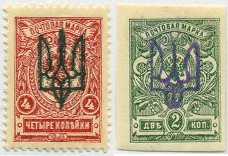
While Ukraine did initially issue a set of 5 stamps (called the Shagiv issues), in August, 1918, Ukrainian authorities ordered that all available stocks of Imperial Russian stamps be overprinted with the tryzub for use in Ukraine. This was done primarily make higher denominations, reduce Russian influence as well as save money by using their inventory of Imperial stamps. Six different city post offices overprinted the stamps, each with their own versions of the tryzub. A host of different designs and variations were issued. The Ukrainian Philatelic and Numismatic Society has put together a nice summary of the various versions of the trident, which I have included in my Ukraine Stamp Album.
Republic of Armenia (pre-USSR)
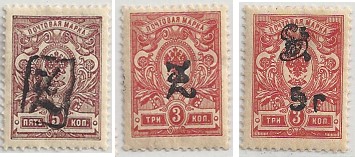
While technically not a symbol, the first two overprints, which resemble the letter "Z", were formed by the combination the Armenian letters for H and P. Referring to Haykakan Post (Armenian Post), the "Z" symbol is often referred to as the "HP" monogram. The third overprint was used on surcharges of new values. Some say it is a stylized "HH" in the Armenian Alphabet which stand for Hayastanee Hanrapetutiun. Recently others have advocated that it is a combination of the Armeanian letters "DH", which stand for Derutune Hayastanee, meaning State of Armenia. There is a large variety of these overprints available, and common for these types of issues, many are counterfeits.
Chilean Occupation of Peru
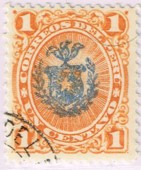
What followed was a three and a half year occupation. For postage, Chilean authorities overprinted Peruvian stamps with the Coat of Arms of Chile for use within occupied areas. Many outlying areas of the country, which supported the resistance, applied their own local overprints or even created their own crude stamps. The occupation ended in Aug 1884, when Chilean troops left the country. The disputed territory was annexed by and remains part of Chile today.
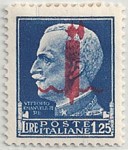
Italian Social Republic
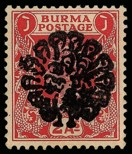
Japanese Occupation of Burma
Japanese Occupation of the Dutch East Indies
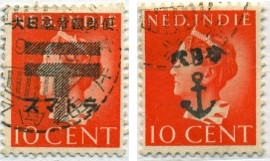
The second emblem shown is an anchor. It was often used by areas occupied by the Japanese Navy, primarily Borneo and many of the outer islands such as Bali and Ambon. The picture shown was issued in North Celebes (today Sulawesi). While this is of course not a national symbol, it does represent Japanese navy control.
Technically, I would consider these as separate "countries", as Japan divided the Dutch East Indies into three separated occupational administrations. Java and Sumatra had separate "governments", and Borneo and the Great East was administered by the navy.
Collecting Dead Countries
While most of the overprints I have been featuring in this blog usually designate sovereignty or control, not all overprints are used for such purposes. I am currently working through my Ottoman Empire stamps, and they use overprints for a wide variety of purposes. Ottoman stamps have overprints to indicate a newspaper stamp, overprints to indicate that buyers get a discount, and overprints to celebrate a sultans visit to a city. In fact, where other countries print and issue commemorative stamps, the Ottoman Empire uses overprints. Being that almost everything is in Turkish, trying to sort through all of them truly lives up to the title of the series "Overprint Madness."
In the next edition of the DCStamps Investigator, I will begin winding up the series by covering some of the very confusing, and more maddening overprinted issues. I will include overprints on overprints and even some issues which are very misleading.
I would love to hear from you by leaving a comment below.
The post DCStamps Investigator - Overprint Madness #3 appeared first on Dead Country Stamps and Banknotes.
Last edited: