M
Michael
Guest
- Thread Author
- #1

Issue #5
Feb 23, 2018
Michael Adkins
In this issue of the DCStamps Investigator, we continue our series on the world of overprints on stamps, especially as it relates to dead counties.
Someone asked me why I used the term "Madness" in the title. From what I've covered so far, I can understand the discontinuity. But as we delve deeper into the subject, we will discover that overprints become much more complicated. This is especially true to those newer to worldwide collecting. In the coming weeks we will be discussing subjects such as surcharges only, overprints on overprints, misleading overprints, and of course the bane of all stamp collectors -- counterfeits.
In the last issue of the Investigator, we covered simple overprints, those that used the country name. This week we will go a little deeper, and cover overprints with initials. And of course we will find that they don't always stand for what we think.
Overprints with Initials
Rather than place names, many overprints on "dead country" stamps used initials. Surprisingly, not all initials indicated the stamp issuing entity. We will be looking at six examples of overprints using initials. Each had its own purpose and place in the history of the region. In fact learning about that history adds a whole new dimension to understanding your stamps.
Overprints Initials Representing the Country
The following are examples of overprints with initials which represent the country name. Sometimes understanding them can be a little tricky because the initials are frequently not in English.
French Colony of Annam and Tonkin
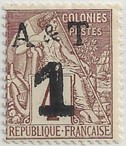
Even though the protectorate was already administratively part of French Indochine, a set of stamps were issued for use in Annam and Tonkin in 1888. Six French Colonies stamps were overprinted with the initials "A&T" or "A-T" and surcharged in French Francs. These stamps were used until 1892, when they were replaced with stamps from Indochine.
Far Eastern Republic

The first stamps of the Far Eastern Republic were issued in April 1920. Imperial Russian stamps were overprinted "DVR" in stylized Cyrillic letters. The letters stand for Dalni Vostochni Respoublika, which is Russian for Far Eastern Republic. The difficulty comes in trying to read overprints using cursive or stylized letters, especially in entirely different alphabet systems.
Eastern Silesia
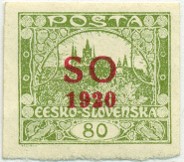
Although no election was called for in Eastern Silesia, a region between Poland and Czechoslovakia, the countries were unable to reach an agreement for drawing the borders. The parties asked the Allies to arbitrate an agreement, while at the same time planned a plebiscite. In order to promote the election, stamps were overprinted "S O / 1920" on issues of Czechoslovakia and Poland. "S O" stood for “Silesie Orientale,” French for Eastern Silesia. The stamps were used in the region from Feb-Sept 1920. Eventually a solution was agreed with the Allies in July, 1920, and the vote was never held.
Overprints Initials Indicating a Broader Meaning
Not all initials used on overprints, indicated the country name. Some stamp issuing entities overprinted stamps for a broader political, propaganda, or even intimidating purpose. While a good stamp catalog will help in identifying the issuing entity and translating the initials, one often needs to dig a little deeper in the history at the time, to understand the purpose.
Occupation of Latvia by the West Russian Army under Col. Bermondt-Avalov
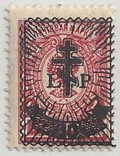
During the activities of the West Russian Volunteer Army, they issued several sets of stamps, all using the symbol of the St. Andrews Cross of the Russian Orthodox Church. These stamps were overprinted and surcharged on Russian Imperial stamps, almost obliterating the entire design. It included the initials "L. P." which, according to my best sources stands for Latvija Pashparvalac. The the meaning of the initials are Latvian for "Free Latvia," trying to indicate that the West Russian Volunteer Army was fighting for Latvian Independence.
Italian Social Republic

One of the roles of the Republican National Guard was to oversee postal and telegraph services. The first stamps issued for the Italian Social Republic, were overprints of "G.N.R." on Italian stamps. “G.N.R.” stood for GUARDIA NAZIONALE REPUBBLICANA, or the Republican National Guard. These stamps, designed as propaganda issues, were valid for postage across the Italian Social Republic from Dec 20, 1943 to Aug, 15, 1944. Although not listed in Scott, most other major catalogs include these issues.
British Occupation of Orange Free State

Great Britain, desiring to gain control of the rich diamond mines, set their sites on the Boers. After a failed war and attempts to instigate revolutions, the British launched a full scale assault on Orange Free State and South African Republic (ZAR) in 1898. After a slow start, British forces overwhelmed their opponents, forcefully conquering and occupying the Boer territories.
As the British gained control of Orange Free State lands, they confiscated the local stamps and overprinted them with the initials. “V.R.I." Standing for "Victoria Regina Imperatrix", Latin for Victoria Queen Empress, this overprint was designed to intimidate and remind the occupied population they were now subjects of the Queen. After the death of Victoria in 1901, some stamps were overprinted "E.R.I." standing for Edward VII.
Collecting Dead Country Stamps to Help Learn History
I like to think that collecting stamps is collecting little pieces of history. To me, rather than filling spaces in an album, I find that understanding the historical context of the stamps brings them into a much richer context. Dead countries can be especially interesting, as most of them are have limited histories, and are usually set in world changing times such as expansions into unexplored lands, the rise and fall of empires, wars, revolutions, and more.
As we continue to work through this series on overprints, hopefully you too can feel the weight of history in your collection.
In the next edition of the DCStamps Investigator, we will talk about symbols on overprinted stamps, and their significance. Until then, please make comments or ask questions below.
The post DCStamps Investigator - Overprint Madness #2 appeared first on Dead Country Stamps and Banknotes.
Last edited: