1

The Great Indian Epics — A Closer Reading
2533
15
Project Gutenberg
2024
India -- Social life and customs -- Fiction; Epic literature, Sanskrit -- Adaptations; Heroes -- India -- Fiction; Hindu mythology -- Fiction
Readers of public-domain and historical texts
Project Gutenberg digital edition
en
Edition facts
Words: 79,539
Reading time: 346 min
Text sections: 24
Source:
Project Gutenberg record #73417
John Campbell Oman's 1900 prose condensation of the Ramayana and Mahabharata, preserving mythological, romantic, and social elements from the Sanskrit epics while omitting much of their original verse and bulk. The text balances narrative momentum with descriptive passages on tirthas, divine weapons, and celestial abodes.
Editorial Edition Score
4.9/5
★★★★★
★★★★★
Calculated from edition completeness, EPUB availability, text structure and catalogue metadata. Not a user rating.
Edition quality
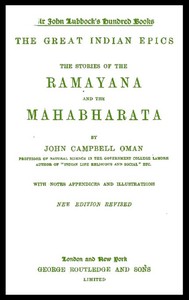
John Campbell Oman’s 1900 adaptation condenses the Ramayana and Mahabharata into a single prose volume, aiming to make the Sanskrit epics accessible to readers deterred by their original length. In his preface, Oman distinguishes his work from historical abstracts, which he calls “skeletons rather than miniatures,” by retaining mythological, romantic, and social details. The resulting text alternates between brisk plot progression and lingering descriptions of sacred geography, divine weaponry, and celestial architecture.
Tirthas and the Accumulation of Merit
Oman devotes considerable space to the Pandavas’ pilgrimage through a series of tirthas (sacred fords), where each bathing site confers specific supernatural rewards. One plunge grants the merit of donating a thousand cows; another bestows invisibility; a third secures a place in Indra’s heaven. The narrative treats these benefits with a matter-of-fact tone, listing them as if tallying a ledger. King Yudhisthira and his brothers “pleasantly acquired an enormous store of merits of various kinds” by moving from tirtha to tirtha, from the Punjab to the Southern Sea. The episode illustrates how the epics embed ritual geography within adventure, turning landscape into a system of spiritual accounting.
Celestial Architecture and Sensory Excess
Oman’s description of Kuvera’s abode exemplifies the epics’ taste for layered, jeweled excess: “adorned with golden and crystal palaces, surrounded on all sides by golden walls having the splendour of all gems.” The passage accumulates details—gardens, ramparts, pennons, dancing damsels, perfumed breezes—in a syntax that mirrors the visual overload. This is not mere decoration; the description establishes Kuvera as a god of wealth whose environment is a direct expression of his domain. Similarly, Arjuna’s return from Indra’s realm is marked by a “blazing chariot” that “filled the sky with its brilliancy,” and Arjuna himself appears “in a resplendent form, adorned with a diadem and celestial garlands.” The text consistently uses light, gems, and fragrance to signal the divine.
Weaponry and the Scale of Combat
Arjuna’s solo campaign against the Nivata-Kavachas—thirty million demons dwelling in the ocean—showcases the epics’ taste for hyperbolic warfare. Oman reports that Arjuna, armed with celestial weapons and riding Indra’s chariot, performed “prodigies of valour and the most marvellous performances” to destroy both the demons and their “wonderful aërial city, Hiranyapura.” The numbers (thirty million) and the combination of underwater and airborne settings push the battle beyond human scale. Yet Oman’s prose remains restrained, summarizing the conflict without the extended combat sequences found in the original. This compression is typical of his method: he preserves the mythic magnitude while trimming the verse’s repetitive catalogues of arrows and divine interventions.
Oman’s condensation foregrounds the epics’ structural reliance on pilgrimage, divine reward, and superhuman combat, while downplaying the genealogical and legal digressions that swell the originals. Readers expecting the full texture of Valmiki or Vyasa will find a streamlined narrative that prioritizes plot and spectacle over philosophical discourse. The volume serves best as an entry point for those who want the story arcs and mythological landscape without the epic’s full bulk.
Reader reflection
Take a moment to reflect on this book
Create a short personal record of your experience with this book.
Your progress
0
/
10
2
Was reading this book enjoyable?
3
Would you recommend this book to another reader?
4
How much effort did this book require?
5
Did the book give you something worth debating?
6
Would a second reading be valuable?
7
How original did the book feel?
8
How did the reading compare with what you expected?
9
What is the main idea you are taking away?
10