1

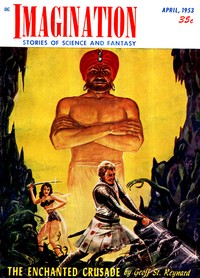
The Enchanted Crusade — A Reader’s Guide
1827
5
Project Gutenberg
2021
Fantasy fiction; Plague -- Fiction; Adventure stories; Magic -- Fiction; Jinn -- Fiction; Crusades -- Fiction
Readers of public-domain and historical texts
Project Gutenberg digital edition
en
Edition facts
Words: 28,827
Reading time: 126 min
Text sections: 3
Source:
Project Gutenberg record #66196
Krepps's 1953 fantasy adventure follows Godwin, a man transformed into a gorilla by the sorcerer Mufaddal, as he leads a prison break and assault on a plague ship. The prose blends gritty physical detail with sardonic dialogue, notably the woman Ramizail's mocking wit and Godwin's pragmatic brutality.
From its first line, The Enchanted Crusade announces a world where bodily decay and supernatural threat coexist without fuss. A dying man hears “the crunch of horses’ hooves on sand,” lifts his head, and croaks for help before pitching “on his nose again.” The prose is tactile, full of grit and pain, yet the rescue party’s banter undercuts any solemnity: “Name of all camels! What a collection of vulture-victuals this one is!” The woman Ramizail speaks with “honey and laughter,” calling Godwin a “born diplomat” for telling a dying man he looks “like two coppers’ worth of dogmeat.” This tonal mix—visceral description and irreverent dialogue—defines the authorial voice.
Diction of the Body and the Desert
The narrative dwells on physical sensation with clinical specificity. The dying man’s lips and gums are “blackened,” his throat “rasped,” and water reaches his belly as if he were drowning, which “seemed a splendid death.” Godwin’s transformed body is described as “more than six hundred pounds,” with a “bullet head and huge shoulders.” When he jumps from a roof, he lands on two guards who “never knew what crushed them.” The desert is not a romantic backdrop but a “hellish waste” of sand that grinds underfoot. Even a belch is given “classic proportions.” This diction insists on the material reality of a fantastic situation.
Voice and the Comic Undercurrent
Dialogue carries the story’s emotional weight and humor. Ramizail’s teasing—calling Godwin a “born diplomat” for his bluntness—establishes a rapport that leavens the violence. Godwin himself speaks with grim pragmatism: “No sense in lying to a chap who’s about to give up the spirit.” The elderly voice of El Sareuk introduces the trio as “three homeless travelers pledged to right wrongs,” a self-consciously heroic claim that the surrounding banter undercuts. When Godwin, as a gorilla, plucks “tufts of fur out in search of an elusive flea,” the mundane detail punctures any epic pretension. The author uses voice to keep the tone agile, shifting from threat to comedy within a single scene.
Structure of Action and Restraint
The excerpted action sequences show a careful choreography of violence. The prison break is plotted in stages: Godwin assigns targets, gives a signal, and launches himself “with a war-cry that began in his belly and strangled in his throat,” producing only a “sibilant fierce hiss.” The men at the corners work with “practiced, pitiless hands.” The author controls pace by alternating broad strokes (the drinking song from the prisoners) with precise details (the sentries’ turns “made toward the barracks”). After the slaughter, the gorilla says, “The biggest mistake Mufaddal ever made was when he turned me into this monster and then sent me back to the dungeon.” The line reframes the transformation as a tactical error, not a curse.
Recurring Details and Their Implications
Several details recur across the excerpts. The motif of disguise and mistaken identity appears when Godwin’s men don “the distinctive chest armor and helmets” of dead guards to approach the barracks. Earlier, the dying man mistakes the trio for rescuers sent by “the Holy Sepulcher.” The plague ship, mentioned as a goal, ties the adventure to the catalog subject of plague. The author also uses numbers precisely: “sixty-two men and a gorilla” become “ten naked corpses.” This specificity grounds the fantasy in a countable world. The flea that Godwin hunts while discussing a plan with El Sareuk is a small but telling detail—it insists that even a transformed hero has ordinary irritations.
Readers should attend to how Krepps balances the grotesque and the witty. The prose rewards attention to physical detail—the weight of a body, the sound of a hiss, the texture of sand. The dialogue, especially Ramizail’s, offers a counterpoint to the violence. The incomplete excerpts leave the plague ship and Mufaddal’s sorcery unresolved, but the authorial choices visible here suggest a story that values concrete action over explanation.
Reader reflection
Take a moment to reflect on this book
Create a short personal record of your experience with this book.
Your progress
0
/
10
2
How much did you enjoy the reading experience?
3
Would you pass this book on to a friend?
4
How demanding did the text feel?
5
What did you appreciate most?
6
Did the book give you something worth debating?
7
How would you rate its originality?
8
What was its emotional impact?
9
What is the main idea you are taking away?
10