1

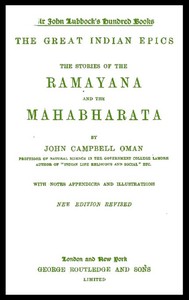
The Great Indian Epics — A Closer Reading
(0 User reviews)
2688
Project Gutenberg
2024
Not confirmed
India -- Social life and customs -- Fiction; Epic literature, Sanskrit -- Adaptations; Heroes -- India -- Fiction; Hindu mythology -- Fiction
Readers of public-domain and historical texts
Project Gutenberg digital edition
en
Edition facts
Words
79,539
Reading time
346 min
Text sections
24
For The Great Indian Epics — A Closer Reading, the stored edition analysis reports 79,539 words, 5 hr 46 min estimated reading time, and 24 detected text sections.
The text analysis averages about 28.0 words per sentence, while the detected sections provide another way to judge how the source is divided.
Project Gutenberg metadata also associates the work with “India -- Social life and customs -- Fiction,” connecting these edition facts with the source record’s subject description.
Source:
Project Gutenberg record #73417
John Campbell Oman's 1900 prose condensation of the Ramayana and Mahabharata, preserving mythological, romantic, and social elements from the Sanskrit epics while omitting much of their original verse and bulk. The text balances narrative momentum with descriptive passages on tirthas, divine weapons, and celestial abodes.
Editorial Edition Score
4.9/5
★★★★★
★★★★★
Calculated from edition completeness, EPUB availability, text structure and catalogue metadata. Not a user rating.
How this score is calculated
- Description quality20 pts
- Title & short description10 pts
- Source metadata20 pts
- Text length15 pts
- Chapters / structure15 pts
- EPUB file integrity20 pts
Total of 100 points, scaled to a 2.5-5.0 range. Editions with an empty description or a missing EPUB file are not scored.
Edition quality
Read the Text
on him by the Creator (Brahma), that neither god nor demon should be able to deprive him of his life. This boon had been obtained by the Rakshasa as the reward of long and painful austerities.[18]
The hierarchy of minor gods, in their own interest and for the sake of the saints who were constantly being disturbed in their devotions by this Ravana and his fellows, appealed to the Supreme Deity to find some remedy for the evil. Brahma, after reflecting on the matter, replied--
“One only way I find To stay this fiend of evil mind. He prayed me once his life to guard From demon, God and heavenly bard, And spirits of the earth and air, And I consenting heard his prayer. But the proud giant in his scorn, Recked not of man of woman born, None else may take his life away But only man the fiend may slay.” --+GRIFFITH.+
On receiving this reply the gods petitioned Vishnu to divide himself into four parts and to appear on earth, incarnate as the promised sons of Dasahratha, and thus, in human form, to rid the world of Ravana. Vishnu consented. He proceeded to the earth and appeared amidst the sacrificial flames of Dasahratha’s offering, in an assumed form “of matchless splendour, strength and size”--black, with a red face, and shaggy hair--apparelled in crimson robes, and adorned with celestial ornaments, holding in his hands a vase of gold, containing heavenly nectar, which he handed to the king, with instructions to make his three queens partake of the sacred draught, in order that they might be blessed with sons.
Dasahratha distributed the nectar amongst his wives, though not in equal proportions. In due time the promised sons were born, viz., Rama, Lakshmana, Bharata and Satrughna. Rama possessed the larger share of the divine nature and decidedly excelled his brothers in prowess. To him, especially, was allotted the task of destroying Ravana. And countless hosts of monkeys and bears were begotten by the gods, at Brahma’s[19] suggestion, to aid him in his work.
Whilst yet a mere stripling, Rama was appealed to by the sage Vishwamitra to destroy certain demons who interrupted the religious rites of the hermits.
The boy was only sixteen years of age, and Dasahratha, naturally solicitous for his safety, declined to let him go to fight the dreadful brood of demons, who had an evil reputation for cruelty and ferocity; but the mighty ascetic waxed so wrath at this refusal of his request, that “the entire earth began to tremble and the gods even were inspired with awe.” Vasishta, the king’s spiritual adviser, who had unbounded confidence in Vishwamitra’s power to protect the prince from all harm, strongly advised compliance with the ascetic’s request, and Dasahratha was prevailed upon to allow Rama and Lakshmana to leave Ayodhya with Vishwamitra.
The incidents of the journey reveal a very primitive state of society. The princes and their guide were all of them on foot, apparently quite unattended by servants and unprovided with even the most ordinary necessaries of life. When they reached the River Surayu,[20] Vishwamitra communicated certain _mantras_ or spells to Rama, by the knowledge of which he would be protected from fatigue and fever[21] and from the possibility of being surprised by the Rakshasas against whom he was going to wage war.
John Campbell Oman’s 1900 adaptation condenses the Ramayana and Mahabharata into a single prose volume, aiming to make the Sanskrit epics accessible to readers deterred by their original length. In his preface, Oman distinguishes his work from historical abstracts, which he calls “skeletons rather than miniatures,” by retaining mythological, romantic, and social details. The resulting text alternates between brisk plot progression and lingering descriptions of sacred geography, divine weaponry, and celestial architecture.
Tirthas and the Accumulation of Merit
Oman devotes considerable space to the Pandavas’ pilgrimage through a series of tirthas (sacred fords), where each bathing site confers specific supernatural rewards. One plunge grants the merit of donating a thousand cows; another bestows invisibility; a third secures a place in Indra’s heaven. The narrative treats these benefits with a matter-of-fact tone, listing them as if tallying a ledger. King Yudhisthira and his brothers “pleasantly acquired an enormous store of merits of various kinds” by moving from tirtha to tirtha, from the Punjab to the Southern Sea. The episode illustrates how the epics embed ritual geography within adventure, turning landscape into a system of spiritual accounting.
Celestial Architecture and Sensory Excess
Oman’s description of Kuvera’s abode exemplifies the epics’ taste for layered, jeweled excess: “adorned with golden and crystal palaces, surrounded on all sides by golden walls having the splendour of all gems.” The passage accumulates details—gardens, ramparts, pennons, dancing damsels, perfumed breezes—in a syntax that mirrors the visual overload. This is not mere decoration; the description establishes Kuvera as a god of wealth whose environment is a direct expression of his domain. Similarly, Arjuna’s return from Indra’s realm is marked by a “blazing chariot” that “filled the sky with its brilliancy,” and Arjuna himself appears “in a resplendent form, adorned with a diadem and celestial garlands.” The text consistently uses light, gems, and fragrance to signal the divine.
Weaponry and the Scale of Combat
Arjuna’s solo campaign against the Nivata-Kavachas—thirty million demons dwelling in the ocean—showcases the epics’ taste for hyperbolic warfare. Oman reports that Arjuna, armed with celestial weapons and riding Indra’s chariot, performed “prodigies of valour and the most marvellous performances” to destroy both the demons and their “wonderful aërial city, Hiranyapura.” The numbers (thirty million) and the combination of underwater and airborne settings push the battle beyond human scale. Yet Oman’s prose remains restrained, summarizing the conflict without the extended combat sequences found in the original. This compression is typical of his method: he preserves the mythic magnitude while trimming the verse’s repetitive catalogues of arrows and divine interventions.
Oman’s condensation foregrounds the epics’ structural reliance on pilgrimage, divine reward, and superhuman combat, while downplaying the genealogical and legal digressions that swell the originals. Readers expecting the full texture of Valmiki or Vyasa will find a streamlined narrative that prioritizes plot and spectacle over philosophical discourse. The volume serves best as an entry point for those who want the story arcs and mythological landscape without the epic’s full bulk.
Oman’s telling of the Indian epics always felt like a lantern-lit path through vast, ancient forests—so much left unseen, yet every step warm with purpose. I found that same quiet fellowship in the old Scandinavian tales, where gods and giants whisper of a shared, colder twilight. Folk-Lore and Legends: Scandinavian — Key Ideas to Explore holds that longing, a memory of ash and dew, as if the two books were cousins resting on my shelf.
There are no reviews for this eBook.
There are no comments for this eBook.
Reader reflection
Take a moment to reflect on this book
Create a short personal record of your experience with this book.
Your progress
0
/
10
2
Was reading this book enjoyable?
3
Would you recommend this book to another reader?
4
How much effort did this book require?
5
Did the book give you something worth debating?
6
Would a second reading be valuable?
7
How original did the book feel?
8
How did the reading compare with what you expected?
9
What is the main idea you are taking away?
10