1

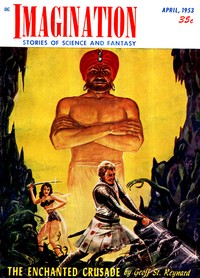
The Enchanted Crusade — A Reader’s Guide
(0 User reviews)
1934
Project Gutenberg
2021
Not confirmed
Fantasy fiction; Plague -- Fiction; Adventure stories; Magic -- Fiction; Jinn -- Fiction; Crusades -- Fiction
Readers of public-domain and historical texts
Project Gutenberg digital edition
en
Edition facts
Words
28,827
Reading time
126 min
Text sections
3
This digital edition of The Enchanted Crusade — A Reader’s Guide is described by source-level measurements including 28,827 words, 2 hr 6 min estimated reading time, and 3 detected text sections.
The text analysis averages about 14.9 words per sentence, while the detected sections provide another way to judge how the source is divided.
Project Gutenberg metadata also associates the work with “Fantasy fiction,” connecting these edition facts with the source record’s subject description.
Source:
Project Gutenberg record #66196
Krepps's 1953 fantasy adventure follows Godwin, a man transformed into a gorilla by the sorcerer Mufaddal, as he leads a prison break and assault on a plague ship. The prose blends gritty physical detail with sardonic dialogue, notably the woman Ramizail's mocking wit and Godwin's pragmatic brutality.
Editorial Edition Score
4.6/5
★★★★★
★★★★★
Calculated from edition completeness, EPUB availability, text structure and catalogue metadata. Not a user rating.
How this score is calculated
- Description quality20 pts
- Title & short description10 pts
- Source metadata20 pts
- Text length15 pts
- Chapters / structure15 pts
- EPUB file integrity20 pts
Total of 100 points, scaled to a 2.5-5.0 range. Editions with an empty description or a missing EPUB file are not scored.
Edition quality
Read the Text
There was the grit of sand under the light tread of men, and a voice said, "Name of all camels! What a collection of vulture-victuals this one is!"
"I doubt it was he cried out," said another voice. "He must have been dead for a decade." This voice then rendered a belch of classic proportions. "Damn those figs," it said.
"If you will eat three pounds at a breakfast, Godwin love," said a throaty feminine voice, all full of honey and laughter, "you must expect some few repercussions."
The dying man collected his will and the scraps of strength that were left in his tortured body, and shoving at the sand with one arm managed to roll over on his back. The horizon-cleared sun lanced sickeningly across his eyeballs, adding one more pain to the thousand which beset him. Three vague dark shapes bent above him.
"By the very God, he lives! Give him a drink."
Water, cool and terrible and yet incredibly wondrous to lips and blackened gums that had tasted nothing save blood for what must surely be centuries, dribbled down across his cheeks, ran into his mouth, reached through his rasped throat for his belly. He gurgled and thought he was drowning, and it seemed a splendid death.
But he had something to say, something of such importance that it had dragged him across this endless waste of hellish sand long after a missionless man would have given up and died. He recollected the message and blinked his nearly sightless eyes once or twice, and made futile little motions toward a sitting position. A brawny arm at his back tilted him upright. "Easy, man. You're all but dead. Don't strive so. Die easily."
"Godwin, you're a born diplomat," said the woman's voice. "Why don't you come right out and tell him he looks like two coppers' worth of dogmeat?"
"Well, he does," Godwin said grimly. "No sense in lying to a chap who's about to give up the spirit, Ramizail. No real man wants that."
"Listen," croaked the dying one. "Who are you?"
"Three adventurers," said the voice that had sworn by the very God. It was an elderly voice but full of vigor. "Three homeless travelers pledged to right wrongs and defeat hell's minions wherever they may be found."
"Thanks to the Holy Sepulcher," groaned the dying one. "Perhaps all may be well."
The man holding him up jerked with surprise. "Here," he said, with a kind of tender roughness, "are you a Crusader, man? Are you a Frank?"
"English," said he. "Sir Malcolm du Findley." He made a hideous rattling noise but from somewhere deep in his soul the power came to make him go on. "El Iskandariya. Big ship. Full of rats."
"What's he burbling about?" asked the deep voice of Godwin. "Poor devil's clean out of his head. Rats? Did rats do this to him?"
"Rats are full of plague," said Sir Malcolm faintly.
"Yes, yes," said the girl. "Ship full of rats, rats full of plague. Go on."
"Can a rat have the plague?" asked Godwin.
"Well, can it?" asked the girl. "Mihrjan, answer me."
A fourth voice, one like muted thunder over distant dunes, said, "Assuredly, O Mistress of My Life, though 'tis not known generally by men in this time."
"He knows it, evidently," said the girl. "Do go on, Sir Malcolm. What about these rats?"
"Ship at El Iskandariya. Going to England, spread plague, decimate whole country. No more Crusades. Saracen plot."
"Now by God and by God, no Saracen stoops that low!" shouted the elderly man.
"Yes. Whole crew of them. Leader--"
"Yes, man; the leader?" urged Godwin.
"Mufaddal al Mamun. Big black-faced swine. His gang can do--anything. Say they can wipe out nine-tenths of England with plague rats, then France, Germany. No more Crusades." He widened his bloody-veined eyes and retching, said, "Tell Richard! Get word to Richard! Got to sink that ship, slay Mufaddal al Mamun! Slay his sorcerers! Promise!"
"We promise," said Godwin. "Decimate England, eh? Plague-infested rats, ha? My halidom! I think not!"
Sir Malcolm, with a grimace that might have been a grin, collapsed in upon himself and died, as peacefully as a man can when he has come seventy miles on foot, over baking sand beneath a searing sun of brass, with a third of his skin flayed off.
Godwin stood up. "Where's El Iskandariya?" he asked.
El Sareuk rubbed his beard with one slim brown hand. "You call it Alexandria. About twenty-five leagues west it lies, my great-thewed friend, on the banks of the Mediterranean."
From its first line, The Enchanted Crusade announces a world where bodily decay and supernatural threat coexist without fuss. A dying man hears “the crunch of horses’ hooves on sand,” lifts his head, and croaks for help before pitching “on his nose again.” The prose is tactile, full of grit and pain, yet the rescue party’s banter undercuts any solemnity: “Name of all camels! What a collection of vulture-victuals this one is!” The woman Ramizail speaks with “honey and laughter,” calling Godwin a “born diplomat” for telling a dying man he looks “like two coppers’ worth of dogmeat.” This tonal mix—visceral description and irreverent dialogue—defines the authorial voice.
Diction of the Body and the Desert
The narrative dwells on physical sensation with clinical specificity. The dying man’s lips and gums are “blackened,” his throat “rasped,” and water reaches his belly as if he were drowning, which “seemed a splendid death.” Godwin’s transformed body is described as “more than six hundred pounds,” with a “bullet head and huge shoulders.” When he jumps from a roof, he lands on two guards who “never knew what crushed them.” The desert is not a romantic backdrop but a “hellish waste” of sand that grinds underfoot. Even a belch is given “classic proportions.” This diction insists on the material reality of a fantastic situation.
Voice and the Comic Undercurrent
Dialogue carries the story’s emotional weight and humor. Ramizail’s teasing—calling Godwin a “born diplomat” for his bluntness—establishes a rapport that leavens the violence. Godwin himself speaks with grim pragmatism: “No sense in lying to a chap who’s about to give up the spirit.” The elderly voice of El Sareuk introduces the trio as “three homeless travelers pledged to right wrongs,” a self-consciously heroic claim that the surrounding banter undercuts. When Godwin, as a gorilla, plucks “tufts of fur out in search of an elusive flea,” the mundane detail punctures any epic pretension. The author uses voice to keep the tone agile, shifting from threat to comedy within a single scene.
Structure of Action and Restraint
The excerpted action sequences show a careful choreography of violence. The prison break is plotted in stages: Godwin assigns targets, gives a signal, and launches himself “with a war-cry that began in his belly and strangled in his throat,” producing only a “sibilant fierce hiss.” The men at the corners work with “practiced, pitiless hands.” The author controls pace by alternating broad strokes (the drinking song from the prisoners) with precise details (the sentries’ turns “made toward the barracks”). After the slaughter, the gorilla says, “The biggest mistake Mufaddal ever made was when he turned me into this monster and then sent me back to the dungeon.” The line reframes the transformation as a tactical error, not a curse.
Recurring Details and Their Implications
Several details recur across the excerpts. The motif of disguise and mistaken identity appears when Godwin’s men don “the distinctive chest armor and helmets” of dead guards to approach the barracks. Earlier, the dying man mistakes the trio for rescuers sent by “the Holy Sepulcher.” The plague ship, mentioned as a goal, ties the adventure to the catalog subject of plague. The author also uses numbers precisely: “sixty-two men and a gorilla” become “ten naked corpses.” This specificity grounds the fantasy in a countable world. The flea that Godwin hunts while discussing a plan with El Sareuk is a small but telling detail—it insists that even a transformed hero has ordinary irritations.
Readers should attend to how Krepps balances the grotesque and the witty. The prose rewards attention to physical detail—the weight of a body, the sound of a hiss, the texture of sand. The dialogue, especially Ramizail’s, offers a counterpoint to the violence. The incomplete excerpts leave the plague ship and Mufaddal’s sorcery unresolved, but the authorial choices visible here suggest a story that values concrete action over explanation.
Reading about Godwin's brute pragmatism and the plague ship brought back a childhood afternoon when I sat with my father's worn copy, and I felt the same shadowy weight of transformation I once found in The Indian Fairy Book From the Original Legends — Background and Themes. Both carry that strange, earthy sorrow of creatures who cannot return to what they were.
There are no reviews for this eBook.
There are no comments for this eBook.
Reader reflection
Take a moment to reflect on this book
Create a short personal record of your experience with this book.
Your progress
0
/
10
2
How much did you enjoy the reading experience?
3
Would you pass this book on to a friend?
4
How demanding did the text feel?
5
What did you appreciate most?
6
Did the book give you something worth debating?
7
How would you rate its originality?
8
What was its emotional impact?
9
What is the main idea you are taking away?
10