1

The black border — Key Ideas to Explore
(0 User reviews)
615
Project Gutenberg
2023
Not confirmed
Tales -- South Carolina; African Americans -- South Carolina -- Folklore; Sea Islands Creole dialect -- Texts
Readers of public-domain and historical texts
Project Gutenberg digital edition
en
Edition facts
Words
97,323
Reading time
424 min
Text sections
50
The black border — Key Ideas to Explore can be approached with a clearer sense of reading commitment from its source measurements: 97,323 words, 7 hr 4 min estimated reading time, and 50 detected text sections.
The text analysis averages about 20.4 words per sentence, while the detected sections provide another way to judge how the source is divided.
Project Gutenberg metadata also associates the work with “Tales -- South Carolina,” connecting these edition facts with the source record’s subject description.
Source:
Project Gutenberg record #71432
A 1922 collection of Gullah folktales and dialect stories from the South Carolina coast, with a glossary. The excerpts reveal a mix of ethnographic framing, local-color fiction, and transcribed oral narratives, raising questions about the relationship between the catalog subjects and the actual content.
Editorial Edition Score
4.9/5
★★★★★
★★★★★
Calculated from edition completeness, EPUB availability, text structure and catalogue metadata. Not a user rating.
How this score is calculated
- Description quality20 pts
- Title & short description10 pts
- Source metadata20 pts
- Text length15 pts
- Chapters / structure15 pts
- EPUB file integrity20 pts
Total of 100 points, scaled to a 2.5-5.0 range. Editions with an empty description or a missing EPUB file are not scored.
Edition quality
Public-domain source text
Read the source text
The source text is kept in the dedicated reader, separate from this catalogue record and its commentary.
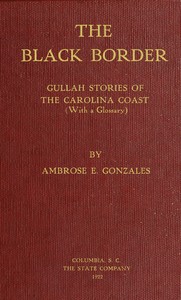
Ambrose E. Gonzales's The Black Border (1922) is cataloged under Folklore, with subjects including "Tales -- South Carolina" and "African Americans -- South Carolina -- Folklore." Yet the excerpts suggest a more complex work: the Foreword opens with a sweeping historical geography of the Slave Coast, describing it as "this fetid armpit of the Dark Continent," before transitioning to a series of stories. The table of contents lists titles such as "Noblesse Oblige," "My Maussuh," and "An Antemortem Demise," alongside fables like "Buh Alligettuh en' Buh Deer" and a glossary of Gullah. The excerpted story about Esau, a fisherman, is told in a literary, descriptive style rather than as a transcribed oral tale, blending third-person narration with dialogue rendered in dialect.
Foreword vs. Folktales: A Tension in Framing
The Foreword situates the Gullah people within a transatlantic history of slavery, using vivid geographic imagery—"Just under the left shoulder of Africa"—and references to Portuguese and English traders. This historical framing is absent from the story excerpts, which focus on individual characters like Esau, a "trifling, ramshackle, youngish negro" who fishes and crabs. The Foreword's tone is analytical and moralizing, while the stories adopt a detached, often humorous narrative voice. The catalog subject "Folklore" may oversimplify a work that mixes ethnographic commentary with fictionalized local-color sketches. The glossary, which appears at the end, further suggests an attempt to document dialect, but the stories themselves are not presented as direct transcriptions of oral performances.
Dialect as Literary Device, Not Transcription
Gonzales renders Gullah speech in stories like the Esau excerpt, where dialogue appears in phonetic spelling: "please, ma'am, en' some greese fuh greese'um." However, the surrounding narration is standard English, with literary flourishes such as "the slow, heaving swells reflected the opalescent tints of the eastern sky." This contrasts with the catalog subject "Sea Islands Creole dialect — Texts," which implies the book contains primary dialect texts. Instead, the dialect is embedded within a narrative frame that controls its presentation. The glossary at the end ("A Glossary of the Gullah") lists words and phrases, but the stories themselves do not function as linguistic records; they are crafted prose. Readers interested in authentic dialect transcription may find the glossary more useful than the tales.
Recurring Motifs: Fishing, the Sea, and Supernatural Encounters
Several story titles reference hunting and fishing: "The Raccoon Hunter," "The Turkey Hunter," "The 'Gator Hunter." The Esau excerpt centers on a fishing trip, with detailed descriptions of bait, tides, and the protagonist's leaky skiff. A supernatural element appears when a shark "as long as his boat" rises and stares at Esau, causing him to mutter "Great Gawd, time fuh gone home!" This blend of mundane labor and eerie encounter recurs in titles like "The Plat-Eye" (a Gullah ghost figure) and "The 'Cunjuh' That Came Back." The catalog subject "Tales -- South Carolina" fits, but the stories are not uniformly folkloric; many are realistic anecdotes with only occasional nods to the supernatural. The line between folklore and fiction is blurred throughout.
Readers approaching The Black Border as a folklore collection should note that its stories are mediated through Gonzales's literary voice. The glossary and Foreword provide context, but the tales themselves are best read as early 20th-century local-color fiction. Pay attention to how dialect is used for characterization rather than documentation, and consider the tension between the book's ethnographic ambitions and its narrative style.
That rainy afternoon, I kept turning pages of The Black Border, caught between the Gullah glossaries and the ghost of dialect voices. What stayed with me wasn’t the folklore’s structure, but its quiet strangeness—how a word could mean two things at once. Later, almost without deciding, I picked up Asneha, the legend of the opal — A Reader’s Guide. It felt like the same dim light, just refracted differently.
There are no reviews for this eBook.
There are no comments for this eBook.
Reader reflection
Record your reading impressions
A brief reflection can help important ideas stay with you longer.
Your progress
0
/
10
2
Did this book hold your interest?
3
Is this a title you would suggest to others?
4
How demanding did the text feel?
5
Would a second reading be valuable?
6
Did any part of the book stay with you emotionally?
7
How valuable was this book for your own interests?
8
Did any part of the book feel personally relevant?
9
What did this book teach you most?
10