1

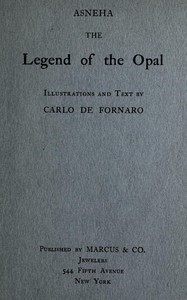
Asneha, the legend of the opal — A Reader’s Guide
(0 User reviews)
1390
Project Gutenberg
2020
Not confirmed
Gems -- Folklore; Opals
Readers of public-domain and historical texts
Project Gutenberg digital edition
en
Edition facts
Words
4,945
Reading time
22 min
Text sections
1
The catalog record for Asneha, the legend of the opal — A Reader’s Guide provides practical reading context through 4,945 words, 22 min estimated reading time, and 1 detected text section.
The text analysis averages about 25.6 words per sentence, while the detected sections provide another way to judge how the source is divided.
Project Gutenberg metadata also associates the work with “Gems -- Folklore,” connecting these edition facts with the source record’s subject description.
Source:
Project Gutenberg record #62512
Carlo de Fornaro's 1902 legend traces a musician's encounter with a golden bird that grants him a magical flute, blending Indian mythology with poetic prose and a caution against earthly love.
Editorial Edition Score
4.4/5
★★★★★
★★★★★
Calculated from edition completeness, EPUB availability, text structure and catalogue metadata. Not a user rating.
How this score is calculated
- Description quality20 pts
- Title & short description10 pts
- Source metadata20 pts
- Text length15 pts
- Chapters / structure15 pts
- EPUB file integrity20 pts
Total of 100 points, scaled to a 2.5-5.0 range. Editions with an empty description or a missing EPUB file are not scored.
Edition quality
Public-domain source text
Read the source text
The source text is kept in the dedicated reader, separate from this catalogue record and its commentary.
Carlo de Fornaro's Asneha, the legend of the opal opens with a poor musician who has lost his flute in a village brawl. Forced to rely on storytelling, he wanders into the jungle and hears a song so extraordinary that he believes himself transported to Indra's heaven. The singer is a small bird with feathers like old gold and emerald eyes, who addresses him as "Asneha" and offers a gift: a reed that will repeat the bird's songs, on condition that he remain pure and avoid the love of woman.
The musician cuts a flute and produces music that ranges from gentle as moonlight on a lake to powerful as the Maruts striking the Himalayas. The prose itself shifts register, from honeyed sweetness to despair, mirroring the flute's range. De Fornaro's diction is ornate and sensory, drawing on Hindu mythology and Baudelaire's epigraph to frame a tale about artistic inspiration and its costs.
Diction and the Sensory Palette
De Fornaro's language is deliberately lush, favoring compounds and similes that appeal to multiple senses. The bird's song is described as "sweet as butter and honey" (from the Rig Veda epigraph), and the flute's music "dripped sweetly as the whitest of honey with the scent of a thousand flowers." The prose often pairs abstract qualities with concrete images: the moonbeam "plays on a silent lake of emerald," and the Maruts' roar is felt "with the shiver of the cold snows from the eternal summits." This sensory layering—sound, sight, taste, touch—creates a textured world where divine and natural elements merge. The author also uses repetition for incantatory effect: "softly," "sweetly," "sadly" accumulate to evoke the flute's emotional range. Such choices align the narrative with oral storytelling traditions, where rhythm and imagery carry meaning beyond plot.
Voice and the Framing of Authority
The narrative voice shifts between third-person omniscience and embedded direct address. The Golden Bird speaks in a formal, imperative tone: "Asneha! thou hast acquired great merit... Therefore, if thou wilt cut a reed..." This archaic second-person pronoun distances the dialogue from ordinary speech, marking the bird as a supernatural authority. The musician, in turn, incises a motto on his flute: "Once upon a time the Golden Bird sang to me, / Now I shall sing a golden song to the gods." This couplet frames his art as both received and transformed—a claim to legitimacy that echoes the story's own structure. De Fornaro also includes a Baudelaire epigraph in French, which introduces themes of voluptuousness and tears, complicating the pure-art ideal. The voice thus oscillates between reverence and sensuousness, hinting at tensions the narrative does not fully resolve.
Structure and the Incomplete Arc
The excerpt presents a complete opening episode: the musician's loss, encounter, gift, and initial success. However, the text cuts off before the legend proper unfolds. The title promises a story about the opal, yet the gem appears only in the catalog metadata, not in the provided text. This gap invites attention to how De Fornaro structures his narrative. The opening uses a frame—"Once upon a time, in the land of Kasi"—that signals a folktale, but the prose's density and the epigraphs suggest a literary rather than oral register. The musician's condition (avoiding love of woman) sets up a potential conflict that the excerpt does not develop. Readers must infer how the opal enters the tale, and whether the flute's magic leads to transgression or transformation. The structure thus remains tantalizingly open, with the legend's core deferred.
Recurring Details and Thematic Threads
Several details recur with symbolic weight. The color green appears in the bird's eyes, beak, and legs, and in the "lake of emerald" simile—a hue associated with the opal's play of color. The number three surfaces: the bird's three green features, the three conditions (merit, kindness, purity), and the three types of music (soft, powerful, sweet). The flute itself is a central object, described as a reed cut from the woods, linking natural material to divine art. The musician's poverty and generosity contrast with the wealth offered by villagers, whom he "scorned, accepting only a little ric..." (the text breaks). This thread of renunciation versus desire may connect to the opal's legendary associations with hope and illusion. De Fornaro weaves these motifs without explicit commentary, leaving readers to trace their resonance.
The Epigraphs as Interpretive Keys
Two epigraphs precede the tale: a stanza from Baudelaire's "L'Invitation au Voyage" and a line from the Rig Veda. The Baudelaire excerpt speaks of a "profound hymn, delicious!" and pearls from eyes—linking tears to gems, a possible bridge to the opal. The Rig Veda line invokes a song "sweet as butter and honey," echoing the flute's honeyed music. Together, they frame the narrative between European symbolist sensuality and Vedic sacred utterance. De Fornaro, an Italian-born author and illustrator, thus positions his legend at a cultural crossroads. The epigraphs do not explain the story but color its reception: the musician's purity is challenged by the Baudelairean voluptuousness, while the Rig Veda grounds his art in ancient ritual. Readers may consider how these competing influences shape the tale's moral and aesthetic dimensions.
Because the provided text breaks off early, readers encounter only the legend's preamble. The opal itself remains absent, and the musician's fate—whether he maintains his purity or succumbs—is unresolved. Pay attention to how De Fornaro's ornate prose and mythological allusions set expectations for a story that may subvert or fulfill them. The interplay of sensory detail and moral warning offers a rich starting point for considering how legends are constructed through language.
Reading Asneha again, I find myself lingering on that golden bird’s song—how it promises everything, yet leaves the musician with only longing. It’s a quiet ache, that. I was reminded of it while leafing through Hawaiian Historical Legends — Background and Themes, where similar old warnings hum beneath the surface. Strange how distant tales keep whispering the same gentle truth to us, if we sit still enough to listen.
There are no reviews for this eBook.
There are no comments for this eBook.
Reader reflection
What was your reading experience?
Capture what you thought, learned, and would like to remember.
Your progress
0
/
10
2
How much did you enjoy the reading experience?
3
Would you recommend this book to another reader?
4
What was the reading difficulty like?
5
How valuable was this book for your own interests?
6
How did the reading compare with what you expected?
7
How strong was your personal connection to the text?
8
Which part made the strongest impression?
9
What changed or sharpened your thinking?
10