
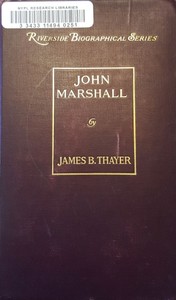
John Marshall by James Bradley Thayer
The Story
Okay, picture this: It's 1801, the U.S. is barely a teenager, and the Supreme Court is a total joke. Six guys meeting in a dusty room in Washington D.C., with no cases to decide and zero respect from anyone, including Thomas Jefferson. Then in walks John Marshall. He’s no cool intellectual (think more like a scruffy cousin who reads law books under a tree). But Thayer lays out how this guy, in secret talks with allies and political manipulation, single-handedly created the power of the Supreme Court. Using real cases—like Marbury v. Madison—Marshall quietly reset the rulebook. He tricked Jefferson’s allies into handing the Court its biggest power: the ability to say 'Hey, that law? Unconstitutional.' This book is basically the backstage pass to how one ordinary-looking man turned a powerless institution into the referee of the whole U.S. government.
Why You Should Read It
I loved this book because it’s not just dusty history. It feels like reading about a guy who built a dynasty using only his brains. Thayer doesn’t trip over academic jargon—he talks about Marshall as a political outsider, a flawed man, but a stubborn one. I kept feeling like I was reading about a tech entrepreneur fighting against old executives, not a judge in a wig. Plus, the way Thayer explains judicial review is crystal clear—even if you’ve never thought about the Constitution, you’ll leave with a new appreciation for that sentence we scroll past on Twitter. The real hook is Marshall’s relationship with Thomas Jefferson—two Virginia guys, friends once, now mortal enemies over one unassuming branch of government. It’s gossipy, believable, and surprisingly modern.
Final Verdict
Perfect for history buffs who love underdog stories, political junkies, or anyone who watches a legal drama and goes ‘How do real courts work?’ It’s short, sharp, and feels like Thayer is sitting across from you over coffee telling you the best inside story. If you want a heavyweight legal hero without the sleep-inducing part, grab this one.
This text is dedicated to the public domain. It is now common property for all to enjoy.
Patricia Brown
1 year agoOne of the most comprehensive guides I've read this year.