
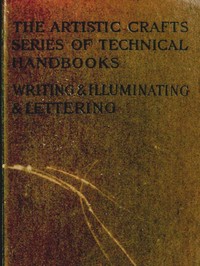
Writing & Illuminating, & Lettering by Edward Johnston
Let's be clear from the start: this is not a novel. There's no plot twist or love triangle. But it does have a story. Writing & Illuminating, & Lettering is the story of how to make beautiful letters by hand, told by the man who taught a whole generation how to do it. Edward Johnston was a craftsman on a mission. In the early 1900s, with factories churning out printed material, the ancient skills of calligraphy and manuscript decoration were fading fast. Johnston saw this, and he wrote this book as a practical, step-by-step rescue manual.
The Story
The book walks you through everything. It starts with the absolute basics: how to sit, how to hold a pen, how to make ink. Then, it builds from there. Johnston explains the shapes of Roman capitals, the flow of italic script, and the structure of Gothic lettering. He doesn't just show you what the letters should look like; he explains why they look that way, how their forms grew from the tools used to make them. The second half gets into the fun stuff—illumination. That's the art of decorating letters and pages with color and gold, like in those old medieval manuscripts. He breaks down this seemingly magical process into achievable steps.
Why You Should Read It
You should read it because it changes how you see the world. After reading Johnston, you'll never look at a street sign, a menu, or a book title the same way. You start to see the skeleton of the letters, the thick and thin strokes, the careful spacing. It gives you a deep appreciation for the craft behind even the simplest printed word. More than that, it's incredibly calming. In our world of digital notifications and rush, there's something profoundly peaceful about Johnston's focus on the slow, deliberate, physical act of making a mark on a page. It's a form of meditation with a very pretty result.
Final Verdict
This book is a foundational text. It's perfect for anyone curious about calligraphy, typography, or book arts. It's for the doodler who wants to level up, the graphic designer looking for historical roots, or the history lover fascinated by craft. It's also for anyone who just needs a break from screens and wants to try a slow, tactile hobby. Be warned: it's a detailed manual, not a light read. But if you have even a passing interest in letters, Johnston's passion is contagious. He doesn't just teach you a skill; he invites you into a centuries-old conversation between the hand, the eye, and the page.
This digital edition is based on a public domain text. You can copy, modify, and distribute it freely.
Kimberly Harris
1 year agoI've gone through the entire material twice now, and the data points used to support the main thesis are quite robust. I appreciate the effort that went into this curation.
Matthew Thompson
2 years agoThis digital copy caught my eye due to its reputation, the clarity of the writing makes even the most dense sections readable. I'll be recommending this to my students and colleagues alike.
Jessica Davis
2 years agoA must-have for graduate-level students in this discipline.
Jennifer Taylor
1 year agoThe balance between academic rigor and readability is perfect.

Patricia Lee
6 months agoI was skeptical about the depth of this book at first, but it addresses the common misconceptions in a very professional manner. This should be on the reading list of every serious professional.