
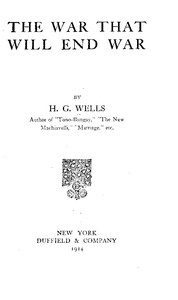
The War That Will End War by H. G. Wells
Let's get this straight from the start: this isn't a novel. If you're looking for the sci-fi adventures of H.G. Wells, you won't find them here. Instead, The War That Will End War is a collection of essays and journalism Wells wrote in the frantic early months of World War I. He published it in 1914, when the war's outcome and its staggering cost were still unknown.
The Story
There isn't a plot in the traditional sense. Think of it as a series of connected arguments. Wells acts as a guide through the political chaos that sparked the war. He points fingers at the old-fashioned diplomacy, secret alliances, and nationalist pride of European empires. His central idea is in the title: he believed this horrific conflict could, and must, be the last one. For Wells, the war wasn't just about beating Germany; it was about smashing the entire old world system to build something new—a unified, peaceful world order, which he sometimes called a 'world state.' He writes with a mix of cold analysis and fiery hope, trying to convince his readers that from this unimaginable bloodshed, a better future must be born.
Why You Should Read It
This book is a time capsule of a specific, heartbreaking moment. Reading it is incredibly powerful because we know what Wells didn't: that a second, even worse world war was coming, and that his hopeful title would become a famous phrase of bitter irony. That knowledge gives every hopeful sentence a tragic weight. You feel his intelligent desperation. He's not a historian looking back; he's a man in the storm, trying to chart a course out of it. It's less about whether his solutions were right or wrong (many were idealistic), and more about witnessing a great mind grapple with a crisis in real time. It makes the history feel immediate and human, not just a list of dates and battles.
Final Verdict
This book is perfect for history buffs who want to move beyond textbooks and feel the pulse of the past. It's also great for anyone interested in politics, peace studies, or the power of ideas. If you enjoy primary sources—hearing history directly from someone who lived it—you'll be fascinated. Just be prepared: it's not a light read. It's a challenging, sobering, and ultimately poignant look at hope in the face of darkness, written by one of the most insightful voices of his age. You'll come away with a deeper understanding of 1914 and a lot to think about regarding war, peace, and the stories we tell ourselves to survive.
This is a copyright-free edition. Access is open to everyone around the world.
Thomas Martinez
1 year agoThe clarity of the introduction set high expectations, and the narrative arc keeps the reader engaged while delivering factual content. An excellent example of how quality digital books should be formatted.

David Thomas
1 year agoThis was exactly the kind of deep dive I was searching for, the nuanced approach to the central theme was better than I expected. It definitely lives up to the reputation of the publisher.