1

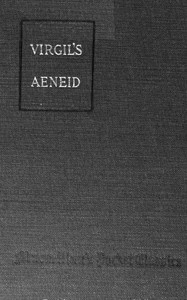
The Æneid of Virgil translated into English prose — Edition Insights
58
16
Project Gutenberg
2024
Epic poetry, Latin -- Translations into English; Aeneas (Legendary character); Legends -- Rome
Readers of public-domain and historical texts
Project Gutenberg digital edition
en
Edition facts
Words: 130,754
Reading time: 569 min
Text sections: 30
Source:
Project Gutenberg record #73488
John Conington's prose translation of Virgil's Aeneid, edited by Edgar S. Shumway for classroom use, is examined through its opening, middle, and later excerpts to show how the translator's choices shape a first reading of the epic.
Editorial Edition Score
4.9/5
★★★★★
★★★★★
Calculated from edition completeness, EPUB availability, text structure and catalogue metadata. Not a user rating.
Edition quality
John Conington's English prose translation of the Aeneid, as edited by Edgar S. Shumway for the Macmillan Pocket American and English Classics series, presents Virgil's epic in a form that prioritizes clarity and directness over poetic ornament. The excerpts available—spanning Juno's furious soliloquy in Book VII, her summoning of Allecto, and the goddess's manipulation of Queen Amata—offer a concentrated view of the translator's approach. Conington renders Virgil's dense Latin into a flowing but unadorned prose, preserving the emotional intensity of speeches while avoiding the archaisms common in verse translations. This edition, with its school-oriented apparatus, invites readers to focus on narrative momentum and character psychology rather than metrical effects.
Juno's Voice in Prose
The excerpt from Book VII opens with Juno's bitter monologue, where Conington's prose captures her indignation through sharp rhetorical questions: “Did the dead really fall on the plains of Sigeum? were the captives captured in truth?” The translation maintains the goddess's sarcastic tone without padding. Phrases like “Spent on these Teucrians is all that sky and surge can do” convey her frustration compactly. Conington avoids Latinate inversion, instead using natural English word order that keeps the speech urgent. The prose rhythm mirrors Juno's mounting anger, with short clauses building to her threat: “I will stir up the fiends of the deep.” This directness makes the supernatural conflict feel immediate, even without verse lineation.
Allecto's Vivid Description
When Juno summons Allecto, Conington's translation becomes visually precise. The fiend is described as one “whom bitter wars, and strifes, and stratagems, and injurious crimes cheer like a cordial.” The simile is rendered plainly, yet the accumulation of nouns creates a cumulative effect. The detail of “vipers that burgeon blackly from her head” uses the verb “burgeon” to suggest growth, a choice that feels both accurate and slightly unexpected. Conington does not gloss over the grotesque: Allecto is “hateful even to Pluto her sire.” The prose here balances mythological exposition with sensory detail, allowing readers to picture the infernal figure without the distraction of poetic meter. This passage demonstrates how prose can achieve vividness through precise word choice rather than rhythmic patterning.
Amata's Possession as Psychological Drama
The scene of Allecto's attack on Queen Amata is rendered with clinical clarity. The snake “glides unfelt, winding between the robe and the marble breast, and beguiles her into frenzy.” Conington uses “beguiles” to imply deception, not mere force, emphasizing the psychological dimension. The queen, who “was glowing and seething with all a woman's passion, a woman's spleen,” is described in terms that suggest internal turmoil before the external intervention. The translation avoids melodrama; the possession unfolds through physical details—the snake's movement, the viperous breath—rather than abstract frenzy. This approach makes the supernatural event credible within the narrative logic, as Amata's preexisting emotions are amplified rather than replaced. Conington's prose here serves the story's coherence, grounding divine action in human psychology.
Conington's Editorial Choices
The excerpts reveal Conington's tendency to break Virgil's longer periods into shorter, more manageable sentences. For instance, Juno's speech in the original Latin is a single sustained outburst; Conington segments it with dashes and line breaks, as seen in “but delays and impediments may well be where the matter is so great; but to cut off the subjects of our two monarchs—this may be done.” This parsing aids comprehension but alters the rhetorical sweep. Proper names are consistently anglicized: “Teucrians” for Trojans, “Laurentine” for the kingdom. The translation also includes brief explanatory notes in brackets, such as “[243]” referencing a footnote, which signals the edition's pedagogical intent. Readers should note that these interventions shape the experience, making the epic more accessible while inevitably simplifying its texture.
For a first reading, these excerpts suggest that Conington's prose translation rewards attention to character speech and descriptive economy. The absence of verse may disappoint those expecting a poetic rendering, but the clarity of the narrative line and the psychological depth of figures like Juno and Amata emerge strongly. Readers might compare this version with a verse translation to see how form affects tone. The edition's school-oriented notes and apparatus are minimal in these passages, so the text itself carries the interpretive weight.
Reader reflection
Before you leave, reflect on the book
Use these questions to collect your thoughts before moving on.
Your progress
0
/
10
2
Was reading this book enjoyable?
3
Would you pass this book on to a friend?
4
How easy was the book to follow?
5
Was the book what you thought it would be?
6
Could you follow the author’s main argument?
7
How distinctive were its ideas or approach?
8
Did you gain anything practical from the text?
9
What changed or sharpened your thinking?
10