
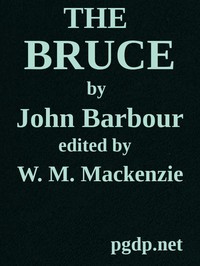
The Bruce by John Barbour
Let's be clear from the start: The Bruce isn't a modern novel. It's a long narrative poem written in the 1370s by John Barbour, a Scottish scholar who was alive during the events he describes. That closeness in time gives it an incredible energy. It's part history, part legend, and all epic story.
The Story
The book follows the life of Robert the Bruce, from his contentious rise to the Scottish throne through the long, brutal Wars of Independence against England. We see his early setbacks and terrible defeats, like the disaster at Methven. The story hits its lowest point when Bruce is a fugitive, hiding in the hills and caves. This is where the famous (and possibly legendary) "spider in the cave" story comes from, a moment of pure perseverance. From there, it's a story of comeback. Bruce uses guerrilla tactics, rallies scattered supporters, and fights a series of smaller battles to regain control. The narrative builds toward its climax: the legendary Battle of Bannockburn in 1314, where Bruce's outnumbered Scots face the full might of the English army in a do-or-die fight for Scotland's freedom.
Why You Should Read It
You read this for the raw, foundational myth. Barbour wasn't trying to be perfectly objective; he was crafting a national hero. Because of that, Bruce leaps off the page. He's not a flawless statue. We see his doubts, his calculated political moves, and his sheer stubbornness. The themes are timeless: what does freedom really cost? What kind of leader emerges from desperation? It's also a fascinating look at medieval values—chivalry, loyalty, and the weight of a king's promise. Reading it, you feel like you're getting the unofficial, passionate backstory to everything that came later in Scottish history.
Final Verdict
This is a book for the patient and curious reader. It's perfect for history buffs who want to go beyond the facts and feel the story, for lovers of epic poetry like The Iliad, and for anyone fascinated by how nations build their founding legends. The language is Middle Scots, so a good modern translation is essential (I recommend the one by A.A.M. Duncan). Don't rush it. Savor the speeches, the descriptions of combat, and the moments of quiet resolve. The Bruce is the thrilling, foundational text of Scotland, and it still has the power to inspire.
Legal analysis indicates this work is in the public domain. You are welcome to share this with anyone.
Kimberly Moore
9 months agoAs a professional in this niche, the concise summaries at the end of each section are a lifesaver. It definitely lives up to the reputation of the publisher.
Donald Johnson
1 month agoComparing this to other titles in the same genre, the author’s unique perspective adds a fresh layer to the discussion. I feel much more confident in my knowledge after finishing this.
Karen White
9 months agoIt’s rare to find such a well-structured narrative nowadays, the clarity of the writing makes even the most dense sections readable. An excellent example of how quality digital books should be formatted.
Ashley Perez
1 year agoThe layout is perfect for tablet and e-reader devices.

Jessica Rodriguez
6 months agoThe layout is perfect for tablet and e-reader devices.