
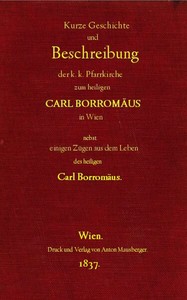
Kurze Geschichte und Beschreibung der k.k. Pfarrkirche zum heiligen Carl…
Imagine finding a detailed guidebook to your local church, written over 170 years ago by someone who never signed their name. That's the experience of reading Kurze Geschichte und Beschreibung der k.k. Pfarrkirche zum heiligen Carl…. On the surface, it's exactly what the title promises: a short history and description of Vienna's St. Charles Church. But the anonymous voice telling the story makes it feel like a secret being shared.
The Story
There isn't a plot in the traditional sense. Instead, the book acts as a tour guide. It walks you through the church built after a plague, describing its Baroque architecture, its altars, and its artwork in clear, almost reverent detail. The 'story' is the building itself—its origins, its purpose, and its place in the heart of the Austrian Empire. The author points out what to look at and explains why it matters, creating a portrait of a community's faith and pride frozen in 1850.
Why You Should Read It
This is where the book gets good. The anonymous author isn't just listing facts. In describing every sacred corner, they reveal what their society valued: order, beauty, memory, and divine protection. Reading it, you feel the weight of history in the stones. You sense the quiet hope that this grandeur would stabilize a changing world. It’s a personal act of preservation by someone who believed this place was important. That passion, even without a name attached, makes the history feel immediate and human.
Final Verdict
This isn't for everyone. If you want a fast-paced novel, look elsewhere. But if you're the kind of person who loves old maps, local history, or wondering about the anonymous people behind historical artifacts, this is a hidden gem. It's perfect for history buffs who enjoy seeing the big picture through a single, focused lens, and for travelers to Vienna who want to connect with a site on a much deeper level. It’s a quiet, thoughtful conversation with the past.
This text is dedicated to the public domain. It is available for public use and education.
David Wilson
4 months agoGreat value and very well written.
Donald Taylor
1 year agoI started reading this with a critical mind, the transition between theoretical knowledge and practical application is seamless. Well worth the time invested in reading it.
Ashley Miller
3 months agoWhile browsing through various academic sources, the inclusion of diverse viewpoints strengthens the overall narrative. Simple, effective, and authoritative – what else could you ask for?
Robert Williams
2 years agoI took detailed notes while reading through the chapters and the way it handles controversial points with balance is quite professional. It definitely lives up to the reputation of the publisher.


Donald White
6 months agoRight from the opening paragraph, the visual layout and supporting data make the reading experience very smooth. I am looking forward to the author's next publication.