1

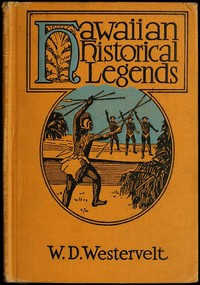
Hawaiian Historical Legends — Background and Themes
1004
19
Project Gutenberg
2021
Folklore -- Hawaii; Legends -- Hawaii
Readers of public-domain and historical texts
Project Gutenberg digital edition
en
Edition facts
Words: 51,648
Reading time: 225 min
Text sections: 23
Source:
Project Gutenberg record #66357
W. D. Westervelt's 1923 collection of Hawaiian legends blends oral tradition with historical records, tracing chiefs, voyages, and conflicts from mythic Maui to Captain Cook's death, using a narrative style that prioritizes story over chronology.
Editorial Edition Score
4.8/5
★★★★★
★★★★★
Calculated from edition completeness, EPUB availability, text structure and catalogue metadata. Not a user rating.
Edition quality
W. D. Westervelt opens his preface with a striking image: "From mist to sunshine—from fabled gods to a constitution and legislature as a Territory of the United States." This phrase signals his method—presenting Hawaiian history as a series of related stories, not a strict chronology. He admits the old Hawaiians "cared very little for dates," and his book follows suit, weaving together legends of kings, priests, and warriors. The excerpts show a narrator who moves fluidly between mythic figures like Maui and historical events like Captain Cook's death, often grounding legendary episodes in specific place names and genealogies. Westervelt's diction is plain but evocative, favoring concrete details—"the large and fertile tract of land on Molokai known as the lands of Halawa"—over abstract commentary. His voice is that of a collector and reteller, not a theorist, and he frequently cites Hawaiian-language newspapers and earlier researchers like Fornander.
Diction of Deception: Kahekili's Crafty Speech
In chapter XII, Westervelt portrays Kahekili, king of Maui, as a master of insinuation. The language is precise: Kahekili "craftily set to work to undermine Kahahana’s faith" and "insinuated that the high priest of Oahu... had been very insincere." Westervelt uses verbs like "insinuated," "impress," and "took pains" to show manipulation through conversation. The king's speech is described as "wily and apparently open-hearted," a contrast that reveals his duplicity. Westervelt does not invent dialogue but summarizes the rhetorical strategy: Kahekili "told Kahahana that the prophet, while pretending to be friendly... had at the same time offered the entire government of Oahu to himself." This indirect reporting keeps the focus on the political cunning rather than dramatic invention. The passage demonstrates how Westervelt uses reported speech to convey character without fabricating quotations.
Violence in Description: The Alapa Regiment
Chapter XIII describes a battle with blunt physicality. Westervelt writes that captives "were unmercifully beaten on their heads with war clubs," and the raid was named "Kalae-ho-hoa"—"pounded on the forehead." The description of combat is stark: "thrusting with spears and striking with clubs meant almost certain death to those who were not able to get in the first blow." Westervelt avoids glorifying violence; instead, he records it as a matter-of-fact consequence of ambition. The phrase "the decimation of the Hawaiian race began in these inter-island wars before the coming of the white race" is a rare editorial comment, linking the legend to a broader historical claim. The battle narrative is structured around cause and effect: Kalaniopuu's desire to "rule two islands instead of one" leads to a raid that ends in "terrible defeat." Westervelt's prose here is efficient, using short clauses to build momentum.
Naming as Historical Clue: Whiro and Punga
Westervelt frequently uses etymology to connect legend to geography. In the preface, he notes that "Hilo, in the island of Hawaii, is named after Whiro, a noted viking who sailed through many island groups with his brother, Punga, after whom the district of Puna is named." This method—tracing place names to legendary voyagers—is a recurring structural device. He calls these figures "vikings of the Pacific," a term that frames Polynesian navigation in familiar European terms. The naming is not presented as definitive proof but as a plausible link: "For instance, Hilo... is named after Whiro." Westervelt's tone is suggestive rather than dogmatic. He also references "Ka-kuhi-hewa, ruler of Oahu," as "the King Arthur of the Hawaiians," another comparative label that makes the legends accessible to an English-speaking audience while acknowledging their distinct cultural roots.
Voice of the Collector: Westervelt's Narrative Stance
Westervelt positions himself as a compiler, not a creator. He writes in the preface that "the old people rehearsed stories depending upon stories told before," and his own role is to gather "fragments of Hawaiian history." His sources include "Hawaiian language papers since 1835, Fornander’s Polynesian Researches, and many of the old Hawaiians." This acknowledgment of oral and written sources gives his narration an ethnographic texture. He occasionally steps in to clarify, as when he explains that the battle name "Kalae-ho-hoa" means "pounded on the forehead" because of the treatment of captives. These glosses are brief and functional. Westervelt's voice is that of a patient explainer, not a dramatic storyteller. He lets the legends speak through summary and selective detail, maintaining a consistent tone of respectful curiosity throughout the excerpts.
Westervelt's legends are best read as a series of linked narratives rather than a single history. Pay attention to how he uses place names and genealogies to anchor myth in geography. The book rewards readers who notice the recurring patterns of political maneuvering and the author's quiet editorial asides. The preface's "mist to sunshine" metaphor is a useful guide: expect stories that move between the supernatural and the political, often without clear boundaries.
Reader reflection
Record your reading impressions
A brief reflection can help important ideas stay with you longer.
Your progress
0
/
10
2
How did the book work for you overall?
3
Would you pass this book on to a friend?
4
How easy was the book to follow?
5
Did the book give you something worth debating?
6
Which element worked best for you?
7
How would you rate its originality?
8
Is this a title worth rereading?
9
Which lesson or insight stayed with you?
10