1

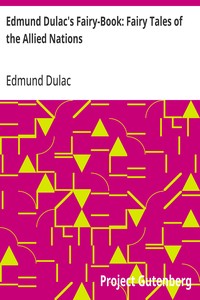
Edmund Dulac's Fairy-Book: Fairy Tales of the Allied Nations — Themes and Context
886
7
Project Gutenberg
2008
Fairy tales
Readers of public-domain and historical texts
Project Gutenberg digital edition
en
Edition facts
Words: 63,109
Reading time: 275 min
Text sections: 8
Source:
Project Gutenberg record #25513
This editorial note examines the authorial choices in Edmund Dulac's 1918 fairy-tale collection, focusing on diction, dialogue, and description across tales from Allied nations, with attention to how the prose shapes narrative tone and character.
Edmund Dulac's Fairy-Book: Fairy Tales of the Allied Nations (1918) presents a curated selection of tales from Russia, England, Flanders, Belgium, Italy, France, Ireland, Serbia, Japan, and China. The prose, likely translated or adapted by Dulac, exhibits a distinctive voice that blends formal narration with vivid sensory detail. In the excerpt from “The Blue Bird,” the description of the storm employs personification and metaphor: “the night flowers paid their perfumes out like threatened debtors.” Such choices elevate the emotional stakes, while dialogue in “Bashtchelik (Or, Real Steel)” is terse and declarative, as when the dying Tsar commands: “It is my will, O my sons, that you give my daughters in marriage.” These stylistic features reveal a deliberate crafting of tone across cultures.
Diction and the Weight of Authority
The language in these tales often carries a formal, almost legalistic weight, especially in moments of command or prophecy. In “Bashtchelik,” the Tsar’s dying words are rendered as a direct, unadorned decree: “It is my will, O my sons, that you give my daughters in marriage.” The repetition of “my” and the imperative structure reinforce patriarchal authority. Contrast this with the storm scene in “The Blue Bird,” where diction shifts to the poetic: “the thunder split and rolled and crashed.” Here, verbs accumulate to mimic the storm’s progression. The narrator also uses simile to externalize emotion: “the night flowers paid their perfumes out like threatened debtors.” Such choices align the natural world with human anxiety, a recurring technique in the collection.
Dialogue as Character Revelation
Dialogue in these excerpts is sparing but pointed, often serving to define character through speech patterns. In “The Blue Bird,” Princess Florine’s wishes are spoken as incantations: “I wish that, by storm and lightning, all that is evil and ugly in this palace shall be destroyed.” The parallel structure and imperative mood give her words performative power. In contrast, the Prince’s dialogue is more reactive: “What sound was that?”—a question that reveals his vulnerability. The Tsar in “Bashtchelik” speaks in clipped, authoritative sentences, leaving no room for reply. These differences in dialogue style—from incantatory to interrogative to commanding—create distinct character voices without lengthy exposition.
Description and the Senses
Descriptive passages in the collection engage multiple senses, grounding the fantastical in the tangible. In “The Blue Bird,” the storm is rendered through sound (“dull thunder reverberated”), touch (“the air grew stifling”), and smell (“the night flowers paid their perfumes”). The phrase “the splash of heavy drops was heard on the flagstones” adds an auditory texture that makes the scene immediate. Later, Florine’s transformation is described through visual excess: “the most splendidly royal figure you could imagine,” with jewels that “could never have got their beauty from any one but her.” This hyperbolic description underscores the fairy-tale logic where beauty correlates with moral worth. Such sensory layering is consistent across the excerpts, though the degree of elaboration varies by tale.
Narrative Voice and Cultural Framing
The narrator’s voice in these tales oscillates between omniscient commentary and restrained observation. In “The Blue Bird,” the narrator occasionally addresses the reader directly: “How could she meet him in her peasant's garb?” This rhetorical question invites empathy. In “Bashtchelik,” the narration is more detached, reporting events without internal access: “The aged Tsar was dying, and his three sons and three daughters were standing round his bed.” The cultural origins of the tales are signaled through names and settings—Snegotchka, Urashima Taro—but the prose style remains consistent, suggesting a unifying editorial hand. Dulac’s choices in diction and pacing thus create a cohesive reading experience while preserving the distinct flavor of each nation’s folklore.
Readers attentive to language will find that Dulac’s editorial choices—the formal decrees, the sensory storms, the incantatory wishes—shape each tale’s emotional landscape. The collection rewards those who listen for shifts in register, from the terse commands of a dying tsar to the lyrical desperation of a princess. These stylistic details, traceable in the excerpts, invite reflection on how fairy tales adapt across cultures while retaining a core narrative power.
Reader reflection
How will you remember this book?
Save your reaction, strongest insight, and memorable passage.
Your progress
0
/
10
2
Did this book hold your interest?
3
Would you recommend this book to another reader?
4
How easy was the book to follow?
5
Which part made the strongest impression?
6
Would you start a conversation about this book?
7
Would you read this book again?
8
How useful were the ideas in this book?
9
What did this book teach you most?
10