1

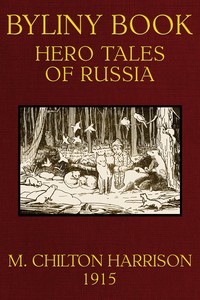
Byliny Book: Hero Tales of Russia — Reading Notes
44
5
Project Gutenberg
2021
Legends -- Russia (Federation); Byliny
Readers of public-domain and historical texts
Project Gutenberg digital edition
en
Edition facts
Words: 18,399
Reading time: 80 min
Text sections: 3
Source:
Project Gutenberg record #66643
This editorial note examines how Marion Chilton Harrison's 1915 retelling of four Russian bylina heroes—Volgá, Mikúla, Svyatogór, and Ilyá—frames the tales for English-speaking children, focusing on the preface's cultural bridge-building and the excerpt's depiction of Ilyá's encounter with Prince Vladímir.
Editorial Edition Score
4.5/5
★★★★★
★★★★★
Calculated from edition completeness, EPUB availability, text structure and catalogue metadata. Not a user rating.
Edition quality
The preface to Byliny Book: Hero Tales of Russia immediately establishes a dual purpose: to introduce young English readers to Russian folklore and to foster wartime sympathy for Russia as an ally in World War I. Harrison explicitly compares Russian heroes to Greek figures like Jason and Heracles, then notes that Russia, France, Italy, and England are “fighting side by side a great fight for freedom.” This framing is absent from the catalog subjects, which list only “Legends -- Russia (Federation)” and “Byliny.” The preface also offers pronunciation guides for hero names—Volgá, Mikúla, Svyatogór, Ilyá—and explains the Cyrillic alphabet as “beautiful, delightful things.” These details reveal a pedagogical intent that goes beyond mere storytelling.
Preface as Cultural Mediation
The preface occupies a significant portion of the text, functioning as a cultural primer. Harrison draws parallels between Russian and Western European heritage: she notes that William the Conqueror brought “beautiful French words” into English, and that the Russians “always liked the Greeks better than the Romans.” She also addresses the difficulty of Russian pronunciation, offering phonetic spellings such as “Mikóolla” and “Eelyā́h.” The preface explicitly states that the book tells of only four heroes—Volgá, Mikúla, Svyatogór, and Ilyá—out of many. This selective focus is not indicated in the catalog subjects, which treat the work as a general collection of bylina. The preface thus shapes reader expectations, emphasizing accessibility and cultural connection over comprehensive coverage.
Ilyá’s Arrival at Kiev: Voice and Structure
The excerpt from Ilyá’s tale shows a distinctive narrative voice that blends direct speech, repetitive action, and folkloric motifs. When Ilyá arrives at Prince Vladímir’s court, he “crossed himself like a good Russian” and “made his bow,” details that reinforce cultural authenticity. The prince’s skepticism—he accuses Ilyá of tavern boasting—prompts Ilyá to display his captive, Nightingale the Robber. The dialogue is brisk and colloquial: “Thou it is who art the fool, O Prince of royal Kiev!” The scene includes repeated commands for Nightingale to “roar like an aurochs” and “whistle like a nightingale,” echoing the preface’s earlier description of the villain’s powers. The structure follows a clear pattern: arrival, greeting, challenge, proof, and resolution. This episodic, oral-derived style is typical of bylina but is here rendered in accessible English prose.
The Role of the Captive: Nightingale the Robber
Nightingale the Robber serves as both antagonist and spectacle. Tied to Ilyá’s stirrup, he is displayed before the court. The courtiers’ demand that he perform his signature sounds—roaring, whistling, howling—treats him as a curiosity. Nightingale’s defiance (“With you I neither eat nor drink, and I will not obey you”) underscores his wildness. Ilyá’s arrow, which “went through his right eye and it came out by the left ear,” is a precise, gruesome detail typical of heroic boasting. The episode also highlights the tension between Ilyá’s rustic heroism and Vladímir’s courtly suspicion. The catalog subjects do not capture this dynamic; they classify the work under “Legends” without noting the specific interplay of skepticism, proof, and performance that drives this scene.
Readers should note that the preface’s wartime context—published in 1915—colors the entire book. Harrison’s explicit goal of making Russian heroes familiar to English children means that the tales are simplified and framed as patriotic parallels. The excerpts show a lively, dialogue-driven narrative, but the full text likely follows the same pattern of episodic encounters and moral tests. Pay attention to how the preface’s cultural notes (pronunciation, alphabet, historical comparisons) prepare you for the stories, and consider what might be omitted or emphasized in this retelling compared to traditional bylina.
Reader reflection
Before you leave, reflect on the book
Use these questions to collect your thoughts before moving on.
Your progress
0
/
10
2
Was reading this book enjoyable?
3
Would you encourage someone else to read it?
4
How demanding did the text feel?
5
Did the book meet your expectations?
6
How much did the book move you?
7
Do you expect to return to this book?
8
How distinctive were its ideas or approach?
9
What did this book teach you most?
10