1

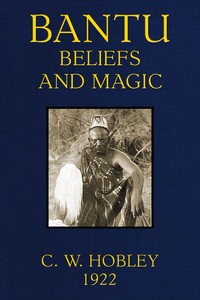
Bantu Beliefs and Magic With particular reference to the Kikuyu and Kamba tribes of Kenya Colony; together with some reflections on East Africa after the war — Inside the Classic
368
4
Project Gutenberg
2022
Folklore -- Africa; Kikuyu (African people); Bantu-speaking peoples -- Folklore; Kamba (African people); Indigenous peoples -- Africa, East
Readers of public-domain and historical texts
Project Gutenberg digital edition
en
Edition facts
Words: 100,157
Reading time: 436 min
Text sections: 29
Source:
Project Gutenberg record #67426
Examines Kikuyu and Kamba beliefs through administrative experience, focusing on twin rituals, reincarnation, and the social logic of taboos, with precise ethnographic detail from early 20th-century Kenya.
Editorial Edition Score
4.9/5
★★★★★
★★★★★
Calculated from edition completeness, EPUB availability, text structure and catalogue metadata. Not a user rating.
Edition quality
C. W. Hobley opens his study with a frank admission: the longer one knows the native, the less one understands—a remark he quickly reframes as an invitation to systematic inquiry. Drawing on decades of administrative work in Kenya Colony, Hobley positions himself as a practitioner-ethnographer, one who insists that governance required close attention to social organization and religious beliefs. The result is a work dense with specific observations, from the treatment of twins among the Kamba to the logic of reincarnation beliefs, all rendered in the plain, observational prose of a colonial officer rather than the speculative tone of an armchair anthropologist.
The Curious Case of Twin Births
Hobley devotes remarkable attention to the divergent customs surrounding twins among the Kikuyu and Kamba. Among the Kamba of Kitui, twins are not killed at birth, as among the Kikuyu, because the mother's second husband could sue the biological father for the children's value. This legalistic detail reveals how kinship obligations could override supernatural fears. The second husband, who must be an elder of council, performs the ithaa ceremony, killing two rams or male goats—one for each twin. The twins must be treated identically: if one receives a present, the other must receive the same; both must marry on the same day, with equal dowries. Hobley notes that the Kamba of Ulu do not believe twins influence rain or weather, contrasting with Kikuyu beliefs. Yet in Kitui, twins born as first children remain unlucky: if both girls survive, the mother will die; if both boys, the father. The supposed mitigation involves the father cohabiting with the mother three days after birth and smearing the couple with the goat's stomach contents (tatha).
Reincarnation and the Naming of Children
Hobley records a belief among the Kitui Kamba that the spirits of the deceased (aiimu) may pray to the deity (Engai) for another body. If a pregnant woman dreams repeatedly of a particular dead person, and then bears a son, the child is given that person's name—a sign that the spirit has returned. This is linked to the concept of a spiritual husband, which Hobley references from his earlier work on the A-Kamba. The passage is striking for its matter-of-fact presentation: Hobley does not dismiss the belief as superstition but treats it as a coherent system. He also notes that a child born feet first is not killed, but must never step over a recumbent person; if he forgets, he must step back over them—a reversal called njokela, meant to undo the ill luck. Such prohibitions, Hobley implies, are not arbitrary but follow a logic of symmetry and reversal.
Taboos on Meat and Deformed Calves
Hobley catalogues a series of food taboos and their rationales. Women are forbidden to eat the meat of a beast that dies naturally, as it is believed to cause stillbirth in a subsequent pregnancy. If a cow bears a dead calf, children may eat it, but not women. A deformed calf is buried, because allowing it to live is said to bring lung trouble among the cattle. Crippled children, however, are not subject to taboo; instead, they are seen as reincarnations of a deceased person similarly afflicted, and are given that person's name. Hobley's presentation of these beliefs is notably non-judgmental: he records the cause-and-effect reasoning without imposing his own evaluation. The effect is to show how the Kamba and Kikuyu systems of belief are internally consistent, even when they differ from European expectations.
The Ethnographer's Voice and Method
Hobley's prose is that of a seasoned administrator who has learned to listen. He acknowledges the difficulty of understanding native life, but insists that patience and systematic study yield results. His preface thanks Sir James Frazer, Sir W. Ridgeway, and Professor Haddon, situating his work within the broader currents of early anthropology. Yet his method is not purely academic: he gathered material through long contact, not through brief fieldwork. The book's structure—moving from general beliefs to specific practices—reflects a desire to be useful to fellow officials and colonists. Hobley's tone is measured, his observations precise, and his willingness to let the evidence speak for itself makes this work a valuable primary source for the beliefs of the Kikuyu and Kamba as recorded in the early 1920s.
Readers approaching this work should expect a detailed, regionally focused ethnography rather than a general survey of Bantu peoples. Hobley's authority derives from his administrative role, and his observations are filtered through that lens. The excerpts provided here offer a glimpse into his method: close attention to variation between tribes, a willingness to record beliefs without immediate judgment, and an implicit argument that these systems are rational within their own terms. For those interested in the intersection of colonial governance and ethnographic documentation, this text is a rich, if partial, record.
Reader reflection
Record your reading impressions
A brief reflection can help important ideas stay with you longer.
Your progress
0
/
10
2
Was reading this book enjoyable?
3
Is this a title you would suggest to others?
4
How demanding did the text feel?
5
How original did the book feel?
6
How did the reading compare with what you expected?
7
What was its emotional impact?
8
Is this a title worth rereading?
9
Which lesson or insight stayed with you?
10