About 383 minutes
Smith and the Pharaohs, and other Tales — Inside the Classic
Folklore
87,929 recorded words. 3 minutes difference from this book's estimate.
View Gutenberg source #6073
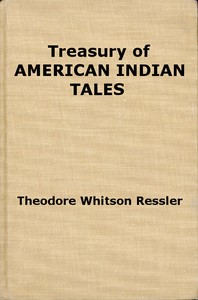
Treasury of American Indian Tales — Edition Insights can be approached with a clearer sense of reading commitment from its source measurements: 88,749 words, 6 hr 26 min estimated reading time, and 11 detected text sections.
The text analysis averages about 17.8 words per sentence, while the detected sections provide another way to judge how the source is divided.
Project Gutenberg metadata also associates the work with “Indians of North America -- Folklore,” connecting these edition facts with the source record’s subject description.
Explore this collection
These alternatives are selected using recorded categories and estimated reading time.
About 383 minutes
Folklore
87,929 recorded words. 3 minutes difference from this book's estimate.
View Gutenberg source #6073About 389 minutes
Folklore
89,378 recorded words. 3 minutes difference from this book's estimate.
View Gutenberg source #59598About 378 minutes
Folklore
86,740 recorded words. 8 minutes difference from this book's estimate.
View Gutenberg source #749Search stored excerpts and compare books → Choose by your preferences →
Choices use stored catalog measurements. Estimates vary with reading speed. A shared category is a catalog label, not a claim that two books have the same argument or literary quality.
Search reads excerpt text stored with this catalog and links to its associated Gutenberg record. The connection is stored in the site database; this tool does not recheck that every excerpt is word-for-word identical to that external record. Excerpt search does not cover every chapter and does not verify historical publication dates.
Catalog snapshot checked: 2026-09-25. Coverage: 94 public books, 94 available source excerpts.
Calculated from edition completeness, EPUB availability, text structure and catalogue metadata. Not a user rating.
Total of 100 points, scaled to a 2.5-5.0 range. Editions with an empty description or a missing EPUB file are not scored.
Public-domain source text
The source text is kept in the dedicated reader, separate from this catalogue record and its commentary.
Theodore Whitson Ressler’s Treasury of American Indian Tales opens with a personal dedication to his son, William Frederick, asserting that “the ways of the Indian were good” and that “honesty and truth were sacred to them; courage, a part of their lives.” This framing signals that the 44 stories, drawn from 27 tribes, are presented as vehicles for moral instruction. The table of contents groups tales under headings such as “Adventure,” “Hunting and Fishing,” “Customs,” “Heroism,” and “Character,” suggesting an organizing principle that emphasizes didactic themes over ethnographic variety.
In the excerpt from “The War That Should Not Have Happened,” Ressler uses dialogue to dramatize a generational and political clash. Great Hawk, an older Comanche, argues for restraint after three horses are stolen, while Crooked Leg, “an old warrior,” inflames younger bucks with cries of “thieving vultures.” The exchange is pointed: Crooked Leg calls Great Hawk “old and weak one,” and Great Hawk counters that the theft was “probably the work of three young bucks” baiting a trap. The dialogue does not merely convey information; it reveals character and stakes. Great Hawk’s measured speech contrasts with Crooked Leg’s incendiary rhetoric, and the young warriors’ shouts of approval show how easily words can tip a group toward violence. Ressler’s dialogue thus serves as a narrative engine, pushing the plot toward a war that the wiser character seeks to prevent.
Ressler’s descriptive style in the same excerpt favors clear, physical action over interior reflection. When Great Hawk “jumped onto a pony and sped off toward the hills,” the sentence is brisk and visual. Later, “he lost the trail of the thieves in the rocks” — a simple observation that carries weight, as it forces the story toward its tragic turn. The author also uses repetition of the word “Wait!” as a motif: Great Hawk raises his hand and says it three times, each time trying to halt the war party. This verbal restraint mirrors the character’s strategic caution. Meanwhile, the young bucks “surged forward toward the hills,” a verb choice that implies an unstoppable momentum. Ressler’s action descriptions are economical, letting the physical movement of characters — riding, shouting, grabbing weapons — carry the emotional and moral weight of the scene.
Based on the table of contents and the excerpt, a structural pattern emerges: many stories center on a young protagonist who learns a lesson through a trial. Titles like “Little Rabbit Discovers a Secret of Strength,” “Little Thunder Finds a Friend,” and “Grey Calf Learns to Hunt Buffalo” suggest a formula of discovery or growth. The excerpt, however, complicates this pattern by focusing on an adult leader, Great Hawk, whose wisdom is ignored by the young. The story’s title, “The War That Should Not Have Happened,” implies a negative outcome, a departure from the more optimistic arcs of other tales. This variation suggests that Ressler does not uniformly apply a moral template; some stories may end in failure or tragedy, reinforcing the gravity of the choices characters make. The collection thus offers a range of outcomes, from successful hunts to preventable wars.
The dedication to Ressler’s son establishes a paternal, instructive voice that permeates the collection. The author states that “the ways of the Indian were good” and that courage was “as much as eating and sleeping.” This framing positions the tales as exemplars of virtue, and the narrative voice often adopts a tone of earnest guidance. In the excerpt, Great Hawk speaks with the same paternal authority: “I, your father, order you to return with me to our tepee.” The parallel between author and character is striking — both are fathers trying to impart wisdom to the next generation. Ressler’s voice, however, does not intrude with explicit moralizing in the excerpt; instead, the lesson emerges from the consequences of the characters’ actions. The dedication thus serves as a key to the author’s intent, but the stories themselves let the drama teach the lesson.
Readers will find that Ressler’s tales reward attention to how characters speak and move. The dialogue often carries the conflict, while the descriptions of action — a hand raised, a pony turned — mark turning points. The collection’s structure, with its thematic sections and recurring patterns of youthful learning, invites comparison across stories. Noting which tales end in success and which in failure can reveal the author’s nuanced view of wisdom and its limits.
Leafing through Ressler’s tales of brave deeds and quiet honesty, I felt that old, familiar ache for voices carried by firelight. It made me think of another collection, gathered just as reverently from storytellers who trusted the spoken word. There is a shared hush in them, a listening quality. I set mine beside Witchcraft & Second Sight in the Highlands & Islands of Scotland Tales and Traditions Collected Entirely from Oral Sources — A Closer Reading, and found the same deep respect for the unseen.
A brief reflection can help important ideas stay with you longer.