1

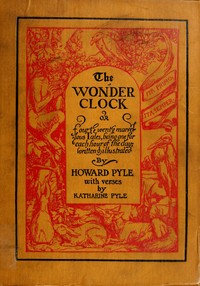
The Wonder Clock; or, four & twenty marvellous Tales being one for each hour of the day — A Closer Reading
(0 User reviews)
134
Project Gutenberg
2020
Not confirmed
Fairy tales; Children's poetry
Readers of public-domain and historical texts
Project Gutenberg digital edition
en
Edition facts
Words
79,653
Reading time
347 min
Text sections
53
This digital edition of The Wonder Clock; or, four & twenty marvellous Tales being one for each hour of the day — A Closer Reading is described by source-level measurements including 79,653 words, 5 hr 47 min estimated reading time, and 53 detected text sections.
The text analysis averages about 21.2 words per sentence, while the detected sections provide another way to judge how the source is divided.
Project Gutenberg metadata also associates the work with “Fairy tales,” connecting these edition facts with the source record’s subject description.
Source:
Project Gutenberg record #63383
Howard Pyle's 1887 collection of 24 fairy tales framed by a visit to Father Time's garret, where a dormant clock releases puppet-like stories. Katharine Pyle's verses accompany each tale. The preface establishes a playful, colloquial narrator who winds the Wonder Clock, setting the tone for the folkloric adventures that follow.
Editorial Edition Score
4.9/5
★★★★★
★★★★★
Calculated from edition completeness, EPUB availability, text structure and catalogue metadata. Not a user rating.
How this score is calculated
- Description quality20 pts
- Title & short description10 pts
- Source metadata20 pts
- Text length15 pts
- Chapters / structure15 pts
- EPUB file integrity20 pts
Total of 100 points, scaled to a 2.5-5.0 range. Editions with an empty description or a missing EPUB file are not scored.
Edition quality
Public-domain source text
Read the source text
The source text is kept in the dedicated reader, separate from this catalogue record and its commentary.
The Wonder Clock opens not with a tale but with a frame: the narrator dons a dream-cap, climbs to Father Time's garret, and winds a long-silent clock. Each hour releases a puppet-show story, and the preface establishes a voice that is colloquial, sly, and fond of repetition—"Good-morning," says Time's Grandmother; "Good-morning," says I. This rhythmic back-and-forth, with its incremental echoes, sets the pattern for the tales themselves. The first excerpt, about Master Jacob and his pig, shows how quickly the narrator shifts from genial preamble to brisk dialogue, with characters repeating phrases like "I say it is a pig!" until the argument becomes a comic chant. The prose moves at a walking pace, then accelerates into farce, then slows again for moral reflection.
The Narrator's Folksy Rhythm
The preface introduces a narrator who speaks as if telling stories by a fire: "I put on my dream-cap one day and stepped into Wonderland." This voice is unhurried, full of asides ("and if you would like to know how old she is you will have to climb to the top of the church steeple") and mild self-deprecation ("I had more than one tumble in doing it"). The prose mimics oral storytelling with its short, additive clauses and repeated sentence openings—"And by and by I came to a steep hill. I climbed the hill… and there, on the tip top, I found a house." This cadence gives the tales a lulling, cumulative quality, as if each sentence is a step along a path. The narrator also uses direct address to the reader, creating a sense of shared conspiracy, especially when introducing rogues or tricks.
Comic Dialogue and Incremental Repetition
In the tale of Master Jacob, dialogue drives the plot through patterned repetition. The priest, provost, and mayor each insist that Jacob's pig is a dog, and the argument escalates in a call-and-response: "I say it is a pig!" / "I say it is a dog!" This structure, repeated three times with each authority figure, turns a simple dispute into a comic ritual. The narrator underlines the absurdity with deadpan commentary: "Well, of course that was a tune to which the others were willing to dance." The repetition serves both humor and narrative economy—it establishes the trick without lengthy explanation. Later, Jacob's own counter-trick uses the same method, showing how the tale's moral ("What is sauce for the goose is sauce for the gander") is embedded in its verbal pattern.
Pace Shifts Between Frame and Tale
The frame narrative moves at a leisurely, descriptive pace: the narrator climbs, observes, winds the clock, and watches puppet figures emerge. Inside the tales, however, the tempo changes abruptly. Master Jacob's story begins with a brisk setup—"Now there were three rogues in the town over the hill"—then plunges into rapid-fire dialogue. The narrator compresses time with phrases like "the next morning off starts Master Jacob" and uses short, punchy sentences for action: "Down he comes into the town." After the climax, the pace slows again for Jacob's reflection and his plan for revenge. This alternation between unhurried frame and brisk tale gives the collection a varied rhythm, preventing monotony across twenty-four stories. The verses by Katharine Pyle, which punctuate each tale, likely serve as further rhythmic breaks.
Readers may find it useful to note how the narrator's voice—chatty, repetitive, and fond of proverbs—shapes each tale's moral. The stories reward attention to their verbal patterns: the same phrase often recurs at key moments, building comic effect or signaling a turn in fortune. The frame's dream-logic (a clock that releases stories) invites a relaxed, episodic reading. Because the excerpts show only one complete tale, the collection's overall range of tone and subject remains to be discovered; but the preface and the pig-trick suggest a consistent, playful intelligence at work.
I kept thinking about how Father Time’s clock spills stories the way old schoolbooks whisper their cadences. That gentle, waiting rhythm—each tale a small breath. The Beacon’s guide feels like that same quiet shelf, a place where words soften into memory. Some evenings, I just sit with the feel of it, the way the wonder clock’s shadow lingers. The Beacon Second Reader — A Reader’s Guide reminds me of that hush, almost like an old friend’s steadying hand.
There are no reviews for this eBook.
There are no comments for this eBook.
Reader reflection
Record your reading impressions
A brief reflection can help important ideas stay with you longer.
Your progress
0
/
10
2
Was reading this book enjoyable?
3
Would you encourage someone else to read it?
4
What was the reading difficulty like?
5
Did the story or argument move comfortably?
6
How much did the book move you?
7
How clear did the writing feel?
8
Did anything about the book feel genuinely new?
9
What is the main idea you are taking away?
10