
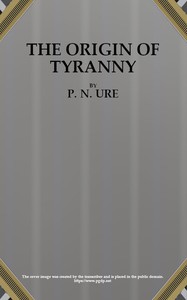
The Origin of Tyranny by P. N. Ure
Let's set the scene. It's not about Rome, or modern Europe. P. N. Ure plants us firmly in the turbulent world of ancient Greece, centuries before its classical golden age. This was a time when society was shifting from old family-based aristocracies to something new, driven by trade, coinage, and a restless class of people left out of the old power structures.
The Story
Ure doesn't follow one narrative. Instead, he investigates a pattern. He looks at city-states like Corinth, Sicyon, and Athens, tracing the rise of figures history labels as the first 'tyrants.' His argument flips the script. These men—Cypselus, Cleisthenes, Peisistratus—often didn't seize power through sheer violence alone. They were frequently middle-class leaders, military men, or wealthy traders who gained support by championing the common people against a stagnant nobility. They built public works, fostered trade, and patronized the arts. Ure's story is about how this specific brand of one-man rule emerged as a direct, and perhaps inevitable, response to deep economic changes and social discontent.
Why You Should Read It
What grabbed me was how current it felt, even though it was written last century about events millennia ago. Ure makes you see tyranny not as a cartoonish evil, but as a political symptom. He connects dots between the invention of coinage, the rise of a merchant class, and the erosion of traditional loyalties. You start to see these ancient tyrants as complex figures, reformers who solved one crisis (a corrupt aristocracy) but created another (unchecked personal power). It’s a brilliant reminder that the seeds of oppression are often sown in the soil of genuine grievance and reform.
Final Verdict
This book is perfect for history buffs who want to go deeper than just names and dates, and for anyone curious about the recurring cycles of politics. It's not a light beach read—Ure's analysis is detailed—but his ideas are so compelling that you'll find yourself thinking about them long after. If you've ever asked yourself 'how could people support that?', this book offers one of the oldest answers in the book. A classic work that still has sharp insights for understanding power today.
James Anderson
10 months agoHaving read this twice, it provides a comprehensive overview perfect for everyone. A valuable addition to my collection.
Daniel Williams
1 year agoThe layout is very easy on the eyes.
Aiden Lewis
1 year agoThe fonts used are very comfortable for long reading sessions.







Emma Flores
9 months agoThe layout is very easy on the eyes.