1

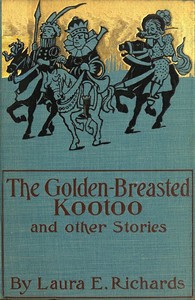
The Golden-Breasted Kootoo, and Other Stories — Context and Discussion
(0 User reviews)
831
Project Gutenberg
2015
Not confirmed
Fairy tales; Fantasy fiction; Children's stories; Wit and humor, Juvenile
Readers of public-domain and historical texts
Project Gutenberg digital edition
en
Edition facts
Words
11,969
Reading time
53 min
Text sections
10
The Golden-Breasted Kootoo, and Other Stories — Context and Discussion can be approached with a clearer sense of reading commitment from its source measurements: 11,969 words, 53 min estimated reading time, and 10 detected text sections.
The text analysis averages about 16.7 words per sentence, while the detected sections provide another way to judge how the source is divided.
Project Gutenberg metadata also associates the work with “Fairy tales,” connecting these edition facts with the source record’s subject description.
Source:
Project Gutenberg record #49750
In this 1885 collection, Laura E. Richards blends nonsense logic with fairy-tale structure, featuring a king who learns to sing from a rubber band, a rocking-horse that wins a race by rocking, and a boy whose constant 'Oh, dear!' triggers a fairy godmother's bell-punch punishment.
Editorial Edition Score
4.7/5
★★★★★
★★★★★
Calculated from edition completeness, EPUB availability, text structure and catalogue metadata. Not a user rating.
How this score is calculated
- Description quality20 pts
- Title & short description10 pts
- Source metadata20 pts
- Text length15 pts
- Chapters / structure15 pts
- EPUB file integrity20 pts
Total of 100 points, scaled to a 2.5-5.0 range. Editions with an empty description or a missing EPUB file are not scored.
Edition quality
Read the Text
one man; that man was the Second Musician, or, as we should now call him, the Chief Musician. He felt no thrill of joy at sight of the wondrous bird; on the contrary, he made his will, and prepared to leave the country at once; but when the pie was finished, and he saw its huge dimensions, he was comforted. “No man,” he said to himself, “can eat the whole of that pie and live!”
Alas! he was right. The unhappy King fell a victim to his musical ambition before he had half finished his pie, and died in a fit. His subjects ate the remainder of the mighty pasty, with mingled tears and smiles, as a memorial feast; and if the Golden-breasted Kootoo _was_ a Shanghai rooster, nobody in the kingdom was ever the wiser for it.
THE STORY OF HOKEY POKEY.
HOKEY POKEY was the youngest of a large family of children. His elder brothers, as they grew up, all became either butchers or bakers or makers of candlesticks, for such was the custom of the family. But Hokey Pokey would be none of these things; so when he was grown to be a tall youth he went to his father and said, “Give me my fortune.”
“Will you be a butcher?” asked his father.
“No!” said Hokey Pokey.
“Will you be a baker?”
“Will you make candlesticks?”
“Then,” said his father, “this is the only fortune I can give you;” and with that he took up his cudgel and gave the youth a stout beating. “Now you cannot complain that I gave you nothing!” said he.
“That is true!” said Hokey Pokey. “But give me also the wooden mallet which lies on the shelf, and I will make my way through the world.”
His father gave him the mallet, glad to be so easily rid of him, and Hokey Pokey went out into the world to seek his fortune. He walked all day, and at nightfall he came to a small village. Feeling hungry, he went into a baker’s shop, intending to buy a loaf of bread for his supper. There was a great noise and confusion in the back part of the shop; and on going to see what was the matter, he found the baker on his knees beside a large box or chest, which he was trying with might and main to keep shut. But there was something inside the box which was trying just as hard to get out, and it screamed and kicked, and pushed the lid up as often as the baker shut it down.
“What have you there in the box?” asked Hokey Pokey.
“I have my wife,” replied the baker. “She is so frightfully ill-tempered that whenever I am going to bake bread I am obliged to shut her up in this box, lest she push me into the oven and bake me with the bread, as she has often threatened to do. But to-day she has broken the lock of the box, and I know not how to keep her down.”
“That is easily managed,” said Hokey Pokey. “Do you but tell her, when she asks who I am, that I am a giant with three heads, and all will be well.” So saying, he took his wooden mallet and dealt three tremendous blows on the box, saying in a loud voice,—
“Hickory Hox! I sit by the box, Waiting to give you a few of my knocks.”
“Husband, husband! whom have you there?” cried the wife in terror.
“Alas!” said the baker; “it is a frightful giant with three heads. He is sitting by the box, and if you open it so much as the width of your little finger, he will pull you out and beat you to powder.”
When the wife heard that she crouched down in the box, and said never a word, for she was afraid of her life.
The baker then took Hokey Pokey into the other part of the shop, thanked him warmly, and gave him a good supper and a bed. The next morning he gave him for a present the finest loaf of bread in his shop, which was shaped like a large round ball; and Hokey Pokey, after knocking once more on the lid of the box, continued his travels.
He had not gone far before he came to another village, and wishing to inquire his way he entered the first shop he came to, which proved to be that of a confectioner. The shop was full of the most beautiful sweetmeats imaginable, and everything was bright and gay; but the confectioner himself sat upon a bench, weeping bitterly.
The title story opens with a king whose kingdom lies "somewhere between Ashantee and Holland" and whose name is a jumble of Samuel, Dolabella, and Chimborazo—a deliberate absurdity that sets the tone for the collection. Richards builds her fairy-tale world not on magic but on literal-minded humor: the king keeps four bands (brass, string, rubber, and a man with a jews-harp) and decides to learn singing because he cannot take the bands hunting. The excerpts show a consistent pattern of treating everyday objects and phrases as springboards for comic fantasy.
Nonsense Logic and Wordplay
The stories operate on a logic that twists ordinary language into plot devices. In "The Golden-Breasted Kootoo," the king's name is a nonsense word that "sounded a little like Samuel, and a little like Dolabella, and a good deal like Chimborazo." The name Chimborazo reappears as the unhappy boy in "Oh, Dear!"—a character whose repeated complaint drives the entire story. The fairy godmother responds by giving him a bell-punch, a mundane object turned punitive tool. Richards does not explain how the bell-punch works; she lets the absurd premise stand.
In "The Ambitious Rocking-Horse," the horse's grammar—"Me's him!"—marks him as a childlike figure, and the jockeys' trick of burning shavings to "turn them into gold" follows a literal interpretation of alchemy. The moral, "Don't be ambitious!," undercuts the fairy-tale convention of rewarded striving.
Objects and Animals as Characters
Richards gives voice and desire to inanimate objects and animals. The rocking-horse wants to be a trotter, sells himself for a bushel of shavings, and is later burned up. The king's musical instruments are personified as bands, and a rubber band is listed alongside brass and string bands without irony. In "The Traveller, the Cook, and the Little Old Man" (partially excerpted), the cook and traveller likely interact with a magical figure, continuing the pattern of everyday beings encountering the fantastic.
The stories avoid elaborate description; characters are defined by a single trait or action. The blind jockey never learns he bought a rocking-horse, and the white buffalo he receives as a prize is mentioned only at the end. Richards focuses on the comic payoff rather than psychological depth.
Structure and Repetition
The collection uses repetition as both a structural device and a source of humor. In "The Golden-Breasted Kootoo," the king's four bands play "all day long" and the musical-boxes play "till daylight did appear." The phrase "Oh, dear!" is repeated four times in the opening lines of that story, and the boy Chimborazo says it "till everybody was tired of hearing it." The fairy godmother's sharp reply—"'Oh, dear!' it is!"—mirrors the boy's own words back at him.
Each story follows a simple arc: a character with a fixed idea encounters a figure who exploits or punishes that idea. The rocking-horse's ambition leads to his destruction; the king's desire to sing presumably leads to the titular Kootoo. The morals, when present, are blunt and deflating.
Readers should approach these stories as verbal play rather than moral instruction. The humor depends on accepting that a rubber band can be a band, a rocking-horse can win a race by rocking, and a boy's whining can be cured by a bell-punch. Richards's fairy-tale framework is a vehicle for jokes, not lessons. The collection rewards attention to how she repurposes ordinary words and objects into comic fantasy.
That rainy afternoon, the Kootoo’s hopping logic felt almost like a half-remembered Celtic air—playful, yes, but with a hollow echo underneath. I closed the book and let my fingers wander the shelf, settling on Fairy Legends and Traditions of the South of Ireland — Background and Themes. There, the nonsense took on a quieter glint, like a bog pool reflecting a sheer drop.
There are no reviews for this eBook.
There are no comments for this eBook.
Reader reflection
Before you leave, reflect on the book
Use these questions to collect your thoughts before moving on.
Your progress
0
/
10
2
How much did you enjoy the reading experience?
3
Is this a title you would suggest to others?
4
Did the language feel accessible?
5
How clear did the writing feel?
6
How would you describe its reading pace?
7
Did the book give you something worth debating?
8
How well did it match your expectations?
9
What did this book teach you most?
10