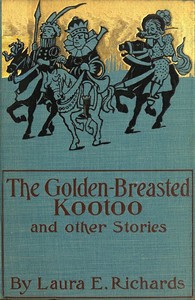
The Golden-Breasted Kootoo, and Other Stories
Edition facts
The title story opens with a king whose kingdom lies "somewhere between Ashantee and Holland" and whose name is a jumble of Samuel, Dolabella, and Chimborazo—a deliberate absurdity that sets the tone for the collection. Richards builds her fairy-tale world not on magic but on literal-minded humor: the king keeps four bands (brass, string, rubber, and a man with a jews-harp) and decides to learn singing because he cannot take the bands hunting. The excerpts show a consistent pattern of treating everyday objects and phrases as springboards for comic fantasy.
Nonsense Logic and Wordplay
The stories operate on a logic that twists ordinary language into plot devices. In "The Golden-Breasted Kootoo," the king's name is a nonsense word that "sounded a little like Samuel, and a little like Dolabella, and a good deal like Chimborazo." The name Chimborazo reappears as the unhappy boy in "Oh, Dear!"—a character whose repeated complaint drives the entire story. The fairy godmother responds by giving him a bell-punch, a mundane object turned punitive tool. Richards does not explain how the bell-punch works; she lets the absurd premise stand.
In "The Ambitious Rocking-Horse," the horse's grammar—"Me's him!"—marks him as a childlike figure, and the jockeys' trick of burning shavings to "turn them into gold" follows a literal interpretation of alchemy. The moral, "Don't be ambitious!," undercuts the fairy-tale convention of rewarded striving.
Objects and Animals as Characters
Richards gives voice and desire to inanimate objects and animals. The rocking-horse wants to be a trotter, sells himself for a bushel of shavings, and is later burned up. The king's musical instruments are personified as bands, and a rubber band is listed alongside brass and string bands without irony. In "The Traveller, the Cook, and the Little Old Man" (partially excerpted), the cook and traveller likely interact with a magical figure, continuing the pattern of everyday beings encountering the fantastic.
The stories avoid elaborate description; characters are defined by a single trait or action. The blind jockey never learns he bought a rocking-horse, and the white buffalo he receives as a prize is mentioned only at the end. Richards focuses on the comic payoff rather than psychological depth.
Structure and Repetition
The collection uses repetition as both a structural device and a source of humor. In "The Golden-Breasted Kootoo," the king's four bands play "all day long" and the musical-boxes play "till daylight did appear." The phrase "Oh, dear!" is repeated four times in the opening lines of that story, and the boy Chimborazo says it "till everybody was tired of hearing it." The fairy godmother's sharp reply—"'Oh, dear!' it is!"—mirrors the boy's own words back at him.
Each story follows a simple arc: a character with a fixed idea encounters a figure who exploits or punishes that idea. The rocking-horse's ambition leads to his destruction; the king's desire to sing presumably leads to the titular Kootoo. The morals, when present, are blunt and deflating.
Readers should approach these stories as verbal play rather than moral instruction. The humor depends on accepting that a rubber band can be a band, a rocking-horse can win a race by rocking, and a boy's whining can be cured by a bell-punch. Richards's fairy-tale framework is a vehicle for jokes, not lessons. The collection rewards attention to how she repurposes ordinary words and objects into comic fantasy.