1

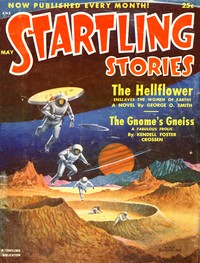
The gnome's gneiss — Themes and Context
(0 User reviews)
144
Project Gutenberg
2022
Not confirmed
Fantasy fiction; New York (N.Y.) -- Fiction; Irish Americans -- Fiction
Readers of public-domain and historical texts
Project Gutenberg digital edition
en
Edition facts
Words
19,194
Reading time
84 min
Text sections
3
This digital edition of The gnome's gneiss — Themes and Context is described by source-level measurements including 19,194 words, 1 hr 24 min estimated reading time, and 3 detected text sections.
The text analysis averages about 13.5 words per sentence, while the detected sections provide another way to judge how the source is divided.
Project Gutenberg metadata also associates the work with “Fantasy fiction,” connecting these edition facts with the source record’s subject description.
Source:
Project Gutenberg record #68892
In this 1952 fantasy novelet, a draft-rejected Irish American New Yorker stumbles into a Troubleshooters, Inc. office and is sent on a mission involving Norse mythology, gnomes, and a television set for Loki. The catalog subjects of Fantasy fiction, New York (N.Y.), and Irish Americans are all present, but the story's actual focus is a comedic collision of modern urban life with ancient gods.
Editorial Edition Score
4.5/5
★★★★★
★★★★★
Calculated from edition completeness, EPUB availability, text structure and catalogue metadata. Not a user rating.
How this score is calculated
- Description quality20 pts
- Title & short description10 pts
- Source metadata20 pts
- Text length15 pts
- Chapters / structure15 pts
- EPUB file integrity20 pts
Total of 100 points, scaled to a 2.5-5.0 range. Editions with an empty description or a missing EPUB file are not scored.
Edition quality
Public-domain source text
Read the source text
The source text is kept in the dedicated reader, separate from this catalogue record and its commentary.
The opening pages of The Gnome's Gneiss immediately establish a sardonic, contemporary voice. Kevan MacGreene, a twenty-five-year-old Irish American, walks lower Manhattan in 1952, brooding not over atomic war or Congress's "Goober-Natural Committee" but over his draft rejection—he was classified an "unstable personality" after admitting to hearing voices. The narrator's tone is dry and amused, treating Kevan's predicament as both absurd and mundane. The story's setting is not a generic fantasy realm but a very specific, satirized New York City, complete with street corners where Fourth Street crosses Twelfth Street and a sign reading "TROUBLESHOOTERS, INC." This blend of urban realism and supernatural intervention is the book's central conceit.
A Satirical New York and a Reluctant Hero
The catalog subject "New York (N.Y.) — Fiction" is accurate but understated. Crossen uses the city not as backdrop but as a character: Kevan's walk through Greenwich Village, his job in Macy's complaint department, and the specific street geography ground the fantasy in a recognizable, mid-century urban landscape. The satire extends to contemporary anxieties—atomic warfare, the cost of living, a columnist apologizing to railroad companies—but Kevan's personal crisis is purely comic. He is a foot-loose young man who wanted to be a hero, even a "radioactive one," but is rejected for being too honest about his inner voices. The story's humor derives from this mismatch between his mundane troubles and the cosmic scale of what he is about to encounter.
Norse Gods and Modern Gadgets
The catalog subject "Fantasy fiction" is correct, but the fantasy is specifically Norse-inflected. Kevan meets Loki, chained in a cave, who complains of boredom. Kevan's solution is to summon a television set via his lapel communicator—a gift he justifies as "good wholesome entertainment" for the god of mischief. The scene plays with the incongruity of ancient mythology and 1950s technology: the TV arrives with a "solid thump," and Loki marvels at the screen. The story's title pun on "gneiss" (a type of rock) and "nice" hints at this playful tone. The excerpts show that the fantasy elements are not treated with reverence but with a knowing, comedic touch, as when Kevan's handler warns him about Loki's true nature while Kevan insists the god seems "very nice."
Irish American Identity and the Troubleshooters Premise
The catalog subject "Irish Americans — Fiction" is present in Kevan's name and heritage, but the excerpts do not develop this into a major theme. More prominent is the Troubleshooters, Inc. premise: Kevan enters a mysterious office and is sent on a mission involving gnomes and Asgard. The story's structure is episodic, with Kevan moving between New York streets and mythological realms via teleportation. The excerpts suggest a fast-paced, dialogue-driven narrative that prioritizes witty banter over deep characterization. The catalog's secondary topic "general-literature" fits, as the book is a light, genre-blending adventure rather than a literary exploration of its subjects.
Readers should approach The Gnome's Gneiss as a period piece of 1950s pulp fantasy, where the humor depends on contemporary references and the pleasure comes from watching a hapless everyman navigate a world where gods need television sets. The catalog subjects hint at the ingredients, but the actual recipe is a brisk, irreverent mix of satire and mythology. The excerpts are incomplete, so the resolution of Kevan's mission and the fate of Loki remain unknown, but the tone suggests a lighthearted conclusion.
Reading about the Troubleshooters' irreverent tangles with Norse gods on 1950s Broadway, I felt a familiar ache—that old hunger for the mythic brushing against a modern city street. It took me back to another volume, The Secret Rose — Text and Context, where Yeats folds ancient symbolism into Dublin’s quiet corners, a gentler, more wistful music for the same longing.
There are no reviews for this eBook.
There are no comments for this eBook.
Reader reflection
Before you leave, reflect on the book
Use these questions to collect your thoughts before moving on.
Your progress
0
/
10
2
Was reading this book enjoyable?
3
Is this a title you would suggest to others?
4
What was the reading difficulty like?
5
Which aspect of the book did you value most?
6
Do you expect to return to this book?
7
Did the book offer a fresh perspective?
8
Would you like to discuss this book with someone?
9
What changed or sharpened your thinking?
10