1

Studies on the Legend of the Holy Grail With Especial Reference to the Hypothesis of Its Celtic Origin — Story, Setting & Ideas
(0 User reviews)
1598
Project Gutenberg
2013
Not confirmed
Grail -- Legends; Grail -- Legends -- History and criticism; Literature, Medieval -- History and criticism; Mythology, Celtic; Arthurian romances -- History and criticism; Knights and knighthood in literature; Quests (Expeditions) in literature
Readers of public-domain and historical texts
Project Gutenberg digital edition
en
Edition facts
Words
130,061
Reading time
566 min
Text sections
18
For Studies on the Legend of the Holy Grail With Especial Reference to the Hypothesis of Its Celtic Origin — Story, Setting & Ideas, the stored edition analysis reports 130,061 words, 9 hr 26 min estimated reading time, and 18 detected text sections.
The text analysis averages about 23.7 words per sentence, while the detected sections provide another way to judge how the source is divided.
Project Gutenberg metadata also associates the work with “Grail -- Legends,” connecting these edition facts with the source record’s subject description.
Source:
Project Gutenberg record #42205
Alfred Nutt's 1888 study examines the Holy Grail legend's possible Celtic origins through comparative analysis of medieval texts, focusing on the Perceval/Peredur tradition and the motif of the broken sword.
Editorial Edition Score
4.8/5
★★★★★
★★★★★
Calculated from edition completeness, EPUB availability, text structure and catalogue metadata. Not a user rating.
How this score is calculated
- Description quality20 pts
- Title & short description10 pts
- Source metadata20 pts
- Text length15 pts
- Chapters / structure15 pts
- EPUB file integrity20 pts
Total of 100 points, scaled to a 2.5-5.0 range. Editions with an empty description or a missing EPUB file are not scored.
Edition quality
Read the Text
Description of the leading forms of the Romance: Conte del Graal--Joseph d'Arimathie--Didot-Perceval--Queste del Saint Graal--Grand Saint Graal--Parzival--Perceval le Gallois-- Mabinogi of Peredur--Sir Perceval--Diu Crône--Information respecting date and authorship of these works in the MSS. page 1
Summaries--Conte du Graal: Pseudo-Chrestien, Chrestien, Gautier de Doulens, Manessier, Gerbert--Wolfram--Heinrich von dem Türlin--Didot-Perceval--Mabinogi of Peredur--Thornton MS. Sir Perceval--Queste del Saint Graal--Grand Saint Graal-- Robert de Borron's poem, Joseph of Arimathea page 8
The legend formed of two portions: Early History of Grail, Quest--Two forms of each portion distinguished--Grouping of the various versions--Alternative hypotheses of development-- Their bearing upon the alleged Celtic origin of the Grail-- Closer examination of the various accounts of the Grail: The first use made of it and its first possessor; its solace of Joseph; its properties and the effect produced by it; its name; its arrival in England; the Grail-keeper and his relationship to the Promised Knight--Three different stages in the development of the Queste--The work and the qualification of the Promised Knight--Conclusions: Priority over Early History of Quest--Chronological arrangement of the versions page 65
SKETCH OF THE LITERATURE CONNECTED WITH THE GRAIL CYCLE.
Villemarqué--Halliwell--San Marte (A. Schulz)--Simrock-- Rochat--Furnivall's reprint of the Grand St. Graal and of Borron--J. F. Campbell--Furnivall's Queste--Paulin Paris-- Potvin's Conte du Graal--Bergmann--Skeat's Joseph of Arimathea--Hucher: Grail Celtic, date of Borron--Zarncke, Zur Geschichte der Gralsage; Grail belongs to Christian legend--Birch-Hirschfeld develops Zarncke's views: Grand St. Graal younger than Queste, both presuppose Chrestien and an earlier Queste, the Didot-Perceval, which forms integral part of Borron's trilogy; Mabinogi later than Chrestien; various members of the cycle dated--Martin combats Birch-Hirschfeld: Borron later than Chrestien, whose poem represents oldest stage of the romance, which has its roots in Celtic tradition--Hertz--Criticism of Birch-Hirschfeld page 97
Relationship of the Didot-Perceval to the Conte du Graal--The former not the source of the latter--Relationship of the Conte du Graal and the Mabinogi--Instances in which the Mabinogi has copied Chrestien--Examples of its independence-- The incident of the blood drops in the snow--Differences between the two works--The machinery of the Mabinogi and the traces of it in the Conte du Graal--The stag hunt--The Mabinogi and Manessier--The sources of the Conte du Graal and the relation of the various parts to a common original--Sir Perceval--Steinbach's theory--Objections to it--The counsels in the Conte du Graal--Wolfram and the Mabinogi--Absence of the Grail from the apparently oldest Celtic form page 127
The Lay of the Great Fool--Summary of the Prose Opening--The Aryan Expulsion and Return Formula--Comparison with the Mabinogi, Sir Perceval, and the Conte du Graal--Comparison with various Gaelic märchen, the Knight of the Red Shield, the Rider of Grianaig--Originality of the Highland tale-- Comparison with the Fionn legend--Summary of the Lay of the Great Fool--Comparison with the stag hunt incident in the Conte du Graal and the Mabinogi--The folk-tale of the twin brethren--The fight against the witch who brings the dead to life in Gerbert and the similar incident in the folk-tale of the Knight of the Red Shield--Comparison with the original form of the Mabinogi--Originality of Gerbert page 152
The various forms of the visit to the Grail Castle in the romances--Conte du Graal: Chrestien; Gautier-Manessier; Gautier-Gerbert--Didot-Perceval--Mabinogi--Conte du Graal; Gawain's visit to the Grail Castle--Heinrich von dem Türlin--Conte du Graal: Perceval's visit to the Castle of Maidens--Inconsistency of these varying accounts; their testimony to stories of different nature and origin being embodied in the romances--Two main types: feud quest and unspelling quest--Reasons for the confusion of the two types--Evidence of the confusion in older Celtic literature-- The Grail in Celtic literature: the gear of the Tuatha de Danann; the cauldron in the Ultonian cycle; the Mabinogi of Branwen; vessel of balsam and glaive of light in the contemporary folk-tale--The sword in Celtic literature: Tethra; Fionn; Manus--Parallels to the Bespelled Castle; the Brug of Oengus, the Brug of Lug, the Brug of Manannan Mac Lir, Bran's visit to the Island of Women, Cormac Mac Art, and the Fairy Branch; Diarmaid and the Daughter of King Under the Waves--Unspelling stories: The Three Soldiers; the waiting of Arthur; Arthur in Etna; the Kyffhäuser Legend, objections to Martin's views concerning it--Gawain's visit to the Magic Castle and Celtic parallels; The Son of Bad Counsel; Fionn in Giant Land; Fionn in the House of Cuana; Fionn and the Yellow Face--The Vanishing of the Bespelled Castle--Comparison with the Sleeping Beauty cycle--The "Haunted Castle" form and its influence on Heinrich's version--The Loathly Grail Messenger page 170
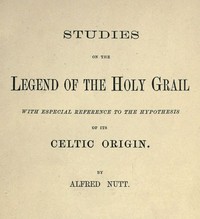
Alfred Nutt opens his study by framing the Grail legend as a problem of origins, immediately engaging with the hypothesis of Celtic derivation. The title page carries epigraphs from Simrock and J. F. Campbell that already stake out the terrain: Simrock asks which people's folktale became attached to the Grail story, while Campbell bluntly equates the Grail with Fionn's healing cup. Nutt's preface, addressed to the Folk-Lore Society, signals that this is a scholarly work grounded in comparative mythology and textual criticism, not a retelling of the romances.
The book's structure is announced by its table of contents: it moves from an examination of the earliest Grail texts—Chrétien de Troyes, the Welsh Peredur, and the Didot-Perceval—through a series of comparative chapters that trace motifs like the broken sword, the loathly damsel, and the talismanic vessel across Celtic and medieval European sources. Nutt's method is forensic: he quotes extensively in Old French and Middle Welsh, then weighs the evidence for borrowing versus independent development.
The Blood-Drops in the Snow: A Test Case for Celtic Priority
One of the most striking passages in the excerpts is Nutt's detailed comparison of the blood-drops episode in Chrétien's Conte du Graal and the Welsh Mabinogi of Peredur. The German scholar Birch-Hirschfeld had argued that the Welsh text simply copied Chrétien. Nutt, following H. Zimmer, points to the Irish saga of the Sons of Usnech—preserved in the Book of Leinster, copied before 1164—where Deirdre's love for Noisi is awakened by a raven drinking blood on snow. The Welsh version, Nutt notes, retains the raven and the three colors (hair like the raven, cheeks like blood, body like snow), while Chrétien omits the raven entirely and focuses on three drops of blood. As Nutt puts it, the Mabinogi's version is "decidedly the more primitive of the two." This is a key piece of evidence for Nutt's larger argument: the Welsh tradition preserves older, Celtic forms of motifs that Chrétien may have reworked.
The Broken Sword and the Fisher King's Ambiguities
Nutt's discussion of the sword-test in the Talisman Castle reveals how carefully he weighs competing explanations. Birch-Hirschfeld had claimed that the Welsh storyteller confused two characters from Chrétien—Gonemans and the Fisher King—because Peredur undergoes a sword test that in Chrétien is associated with a different figure. Nutt counters by noting that Chrétien never explains why the sword is broken, whereas the Mabinogi does provide a reason. He promises to examine the sword incident later in the book, but even in this excerpt, his method is clear: he does not assume that similarity implies borrowing. Instead, he asks which version offers a more coherent narrative logic. The broken sword, like the blood-drops, becomes a test case for whether the Welsh text is derivative or independent. Nutt's approach is to let the textual details—what is explained, what is left mysterious—guide the argument.
The Loathly Damsel and the Stately Castle: Shared Motifs, Divergent Uses
In a passage rich with Old French quotation, Nutt examines the episode of the loathly damsel and the two castles—one with 566 knights, each with his lady, and Castle Orguellos with 570. The damsel's prophecy that "wives will be widowed, and maidens will be left portionless" echoes a formulaic warning found in several romances. Nutt acknowledges that in this case a direct influence from French to Welsh seems probable. But he immediately introduces counter-evidence: the blood-drops incident and the sword test. The pattern is typical of Nutt's argumentation: he concedes points where the evidence for borrowing is strong, then balances them with instances where the Welsh tradition appears older. This even-handedness makes his eventual conclusion—that the Grail legend has deep Celtic roots—more persuasive than a one-sided polemic would be.
Nutt's Comparative Method: Folklore, Philology, and the Weight of Evidence
Throughout the excerpts, Nutt demonstrates a method that combines philological precision with folkloric breadth. He quotes Old French and Middle Welsh in the original, provides his own translations, and cites German scholarship (Simrock, Zimmer, Birch-Hirschfeld) as interlocutors. His footnotes reference the Folk-Lore Record and his own earlier works on Celtic expulsion-and-return formulas. The book is not a narrative but a series of linked investigations, each focused on a specific motif or text. For a first-time reader, the most useful approach is to treat each chapter as a self-contained argument that builds toward a cumulative case. Nutt often states a hypothesis, presents the evidence for and against, and then leaves the verdict open until more data can be examined. This makes the book demanding but rewarding: the reader is invited to follow the reasoning rather than simply accept a conclusion.
Nutt's study is best read with the primary texts at hand—Chrétien's Conte du Graal, the Welsh Peredur, and the Didot-Perceval—since he quotes them extensively and expects the reader to follow his comparisons. Pay attention to the footnotes, where Nutt often stores his sharpest observations and his responses to other scholars. The book is a work of Victorian erudition, but its core question—whether the Grail legend is ultimately Celtic or Christian in origin—remains alive in Arthurian studies today.
Alfred Nutt’s tracing of the broken sword through Perceval brought back a damp evening long ago, when I first felt how a story’s missing piece can ache more than its climax. Reading The high deeds of Finn, and other bardic romances of ancient Ireland — Background and Themes gave me that same quiet shiver—ancient threads still humming under the noise, waiting to be held.
There are no reviews for this eBook.
There are no comments for this eBook.
Reader reflection
Record your reading impressions
A brief reflection can help important ideas stay with you longer.
Your progress
0
/
10
2
What was your overall reaction to the book?
3
Would you encourage someone else to read it?
4
How demanding did the text feel?
5
How did the reading compare with what you expected?
6
How distinctive were its ideas or approach?
7
Could you see yourself revisiting this book?
8
Would you like to discuss this book with someone?
9
Which lesson or insight stayed with you?
10