1

Sindbad the Sailor, & Other Stories from the Arabian Nights — Key Ideas to Explore
(0 User reviews)
1662
Project Gutenberg
2014
Not confirmed
Fairy tales; Arabs -- Folklore; Folklore -- Arab countries; Fairy tales -- Arab countries
Readers of public-domain and historical texts
Project Gutenberg digital edition
en
Edition facts
Words
73,052
Reading time
318 min
Text sections
7
Sindbad the Sailor, & Other Stories from the Arabian Nights — Key Ideas to Explore can be approached with a clearer sense of reading commitment from its source measurements: 73,052 words, 5 hr 18 min estimated reading time, and 7 detected text sections.
The text analysis averages about 22.4 words per sentence, while the detected sections provide another way to judge how the source is divided.
Project Gutenberg metadata also associates the work with “Fairy tales,” connecting these edition facts with the source record’s subject description.
Source:
Project Gutenberg record #47285
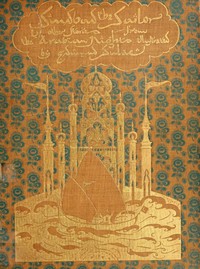
This edition pairs four tales from the Arabian Nights—Sindbad's seven voyages, Aladdin, the Three Calenders, and The Sleeper Awakened—with Edmund Dulac's illustrations. The editorial note examines how the stories use repeated structural patterns, such as voyages and transformations, and how Dulac's images capture key moments of encounter with the marvelous.
Editorial Edition Score
4.7/5
★★★★★
★★★★★
Calculated from edition completeness, EPUB availability, text structure and catalogue metadata. Not a user rating.
How this score is calculated
- Description quality20 pts
- Title & short description10 pts
- Source metadata20 pts
- Text length15 pts
- Chapters / structure15 pts
- EPUB file integrity20 pts
Total of 100 points, scaled to a 2.5-5.0 range. Editions with an empty description or a missing EPUB file are not scored.
Edition quality
Read the Text
Others were struggling for life near by and I was able to draw some of them to me. Sore buffetted as we were by wind and wave we mounted that plank and sat astride of it. Thus, through a whole day and night, we drifted before the gale, now descending into despairing hollows of the sea, and now flung up on the mountain tops of billows. At dawn on the following day the sea cast us like dead men upon an island, where, for many hours, we lay exhausted. Albeit, strength began to return to us again, and we arose feebly, and staggered forth into the island. Fruit and herbs there were in abundance, and clear fresh water; so we ate and drank and were revived.
That night we slept upon the shore, and in the morning we arose strengthened and invigorated. When we had broken our fast we set ourselves to explore the island, and had not gone far in this before we came to a great building. As we stood at the door of this, wondering who dwelt within, a party of naked men came out, and without a word, seized us and led us in to a spacious apartment, where we found ourselves standing before their King. He commanded us to be seated, and they brought us food of a strange kind, such as we had never seen. My companions ate largely of this but my stomach revolted at it and I ate but little--a thing which preserved me from a terrible fate. For, as my companions ate, they became mad with a ravenous hunger, and ate more and more. Presently they were given cocoanut oil to drink, and, when they had swallowed it, their eyes rolled in their heads, and they continued to eat in a frenzy horrible to behold.
I was consumed with fear at these things and said within myself, "This is a tribe of the Magi and their King is a ghoul!" As I observed them attentively I remembered a story of these people: how they seize on travellers and set this loathsome food before them to eat, and give them the oil to drink, so that they swell out and eat more and more until they are fattened to an enormous degree and their minds are rendered like those of idiots; whereupon, in due time, they kill and roast them and serve them up as food to their King. And all these things I saw in the days that my companions were fattening, for there were others who had been seized before us, and each day one of these was killed and roasted and set before the King.
While I was wasting away with fear and hunger--and it was on this account that they forgot me and left me to die in my own way--my companions had come to be like dull, heavy, stupid beasts of the field, so that they were placed in the care of a beastherd, who led them forth every day to the pasturage. As for myself, as soon as I observed that I was a failure in that I would not fatten, and that none took heed of me nor marked my coming or my going, I arose in the night and crept away among the trees surrounding the King's dwelling. Then, when morning came, I went forth with a heart of fear, knowing not what fresh terror I should encounter. In my wanderings back and forth I came about midday to a stretch of green pasture, where I beheld with sorrow my late companions grazing on all fours, and fattening like beasts for the slaughter, while the beastherd sat upon a rock and piped on an oaten reed. I breathed a silent farewell to them as to those I should never see again, and turned sadly away.
This collection presents four tales from the Arabian Nights—Sindbad the Sailor's seven voyages, Aladdin and the Wonderful Lamp, the story of the Three Calenders, and The Sleeper Awakened—in a 1914 edition illustrated by Edmund Dulac. The volume’s structure is notable for its nested narratives: Sindbad’s voyages are framed by his encounters with the poor Sindbad the Landsman, while the Calenders’ tales are embedded within a larger story of a porter and three ladies. Dulac’s illustrations, listed in the contents as episodes such as “The Episode of the Whale” and “The Episode of the Rokh,” emphasize moments of peril and transformation, often depicting the instant before or after a supernatural event.
Recurring Patterns in the Voyages
Sindbad’s seven voyages follow a consistent rhythm: shipwreck or abandonment on an unknown shore, discovery of a marvel (a giant whale, a roc’s egg, a valley of diamonds), and a narrow escape that yields treasure. The text repeats key phrases such as “I was left alone” and “I gave myself up for lost,” reinforcing a sense of isolation before each reversal. The voyages also share a structural symmetry: the first and seventh both end with Sindbad returning to Baghdad and vowing to travel no more, yet each time he is compelled to set out again. This pattern suggests a cyclical view of fortune, where wealth is won through repeated risk.
Movement Between Worlds in Aladdin
Aladdin’s story is built on rapid shifts between humble and royal settings. The excerpt shows Aladdin arriving at the Sultan’s palace “as the sun rises in glory,” a simile that marks his transformation from a poor boy to a prince. The narrative lingers on the physical movement through space: Aladdin dismounts, the Sultan descends from his throne, and they proceed to the banqueting hall. These transitions are accompanied by descriptions of crowds, music, and ceremony, emphasizing the public nature of Aladdin’s rise. Dulac’s illustrations capture key thresholds, such as Aladdin finding the lamp and the nuptial dance, highlighting moments when the ordinary world gives way to the magical.
The Frame Story and Embedded Narratives
The collection uses a frame structure that layers stories within stories. In the Sindbad section, the sailor’s tales are told to the landsman over several evenings, creating a pause between each voyage. The Three Calenders are introduced by a porter who meets three ladies, and their stories are then told in turn. This nesting creates a sense of distance: the reader hears the tales secondhand, filtered through the reactions of listeners. The frame also allows for shifts in tone—Sindbad’s adventures are perilous, but the landsman’s wonder provides a contrast. Dulac’s frontispiece, showing “Sindbad the Sailor entertains Sindbad the Landsman,” visually reinforces this relationship between teller and audience.
Dulac’s Illustrations as Structural Markers
The list of illustrations reveals a deliberate selection of scenes that emphasize moments of encounter with the supernatural. For Sindbad, the episodes chosen are “The Episode of the Whale,” “The Episode of the Rokh,” “The Episode of the Snake,” and “The Episode of the Old Man of the Sea”—each a pivotal confrontation. In Aladdin, the illustrations track the acquisition and use of the lamp: finding it, summoning the efrite, and the final rescue in Africa. The Calenders’ illustrations focus on the magical horse and the efrite’s destruction. These images act as visual chapter headings, guiding the reader to key turning points. The absence of illustrations for the quieter domestic scenes suggests that Dulac’s emphasis is on the marvelous rather than the everyday.
Readers approaching this edition may find it useful to attend to the repeated structural patterns—the voyage cycle, the frame story, and the movement between ordinary and magical realms. Dulac’s illustrations offer a visual commentary on these patterns, often freezing the action at the moment of greatest tension. The collection does not provide a single overarching narrative but rather a series of variations on themes of fortune, transformation, and storytelling itself.
This edition’s Sindbad keeps returning to the sea, each voyage a fresh surrender to fortune, and I recalled my own childhood ritual of rereading The three bears — A Reader’s Guide, where the porridge bowl’s repeated discovery felt just as inevitable. Dulac’s painted monsters stirred the same quiet wonder, that patient knowing of what comes next.
There are no reviews for this eBook.
There are no comments for this eBook.
Reader reflection
What was your reading experience?
Capture what you thought, learned, and would like to remember.
Your progress
0
/
10
2
What was your overall reaction to the book?
3
Would you encourage someone else to read it?
4
What was the reading difficulty like?
5
Was the book what you thought it would be?
6
What was its emotional impact?
7
How did the pace of the book feel?
8
Would this book work well in a reading group?
9
In one sentence, what did you learn?
10