
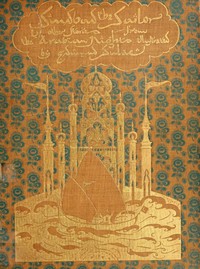
Sindbad the Sailor, & Other Stories from the Arabian Nights
Edition facts
This collection presents four tales from the Arabian Nights—Sindbad the Sailor's seven voyages, Aladdin and the Wonderful Lamp, the story of the Three Calenders, and The Sleeper Awakened—in a 1914 edition illustrated by Edmund Dulac. The volume’s structure is notable for its nested narratives: Sindbad’s voyages are framed by his encounters with the poor Sindbad the Landsman, while the Calenders’ tales are embedded within a larger story of a porter and three ladies. Dulac’s illustrations, listed in the contents as episodes such as “The Episode of the Whale” and “The Episode of the Rokh,” emphasize moments of peril and transformation, often depicting the instant before or after a supernatural event.
Recurring Patterns in the Voyages
Sindbad’s seven voyages follow a consistent rhythm: shipwreck or abandonment on an unknown shore, discovery of a marvel (a giant whale, a roc’s egg, a valley of diamonds), and a narrow escape that yields treasure. The text repeats key phrases such as “I was left alone” and “I gave myself up for lost,” reinforcing a sense of isolation before each reversal. The voyages also share a structural symmetry: the first and seventh both end with Sindbad returning to Baghdad and vowing to travel no more, yet each time he is compelled to set out again. This pattern suggests a cyclical view of fortune, where wealth is won through repeated risk.
Movement Between Worlds in Aladdin
Aladdin’s story is built on rapid shifts between humble and royal settings. The excerpt shows Aladdin arriving at the Sultan’s palace “as the sun rises in glory,” a simile that marks his transformation from a poor boy to a prince. The narrative lingers on the physical movement through space: Aladdin dismounts, the Sultan descends from his throne, and they proceed to the banqueting hall. These transitions are accompanied by descriptions of crowds, music, and ceremony, emphasizing the public nature of Aladdin’s rise. Dulac’s illustrations capture key thresholds, such as Aladdin finding the lamp and the nuptial dance, highlighting moments when the ordinary world gives way to the magical.
The Frame Story and Embedded Narratives
The collection uses a frame structure that layers stories within stories. In the Sindbad section, the sailor’s tales are told to the landsman over several evenings, creating a pause between each voyage. The Three Calenders are introduced by a porter who meets three ladies, and their stories are then told in turn. This nesting creates a sense of distance: the reader hears the tales secondhand, filtered through the reactions of listeners. The frame also allows for shifts in tone—Sindbad’s adventures are perilous, but the landsman’s wonder provides a contrast. Dulac’s frontispiece, showing “Sindbad the Sailor entertains Sindbad the Landsman,” visually reinforces this relationship between teller and audience.
Dulac’s Illustrations as Structural Markers
The list of illustrations reveals a deliberate selection of scenes that emphasize moments of encounter with the supernatural. For Sindbad, the episodes chosen are “The Episode of the Whale,” “The Episode of the Rokh,” “The Episode of the Snake,” and “The Episode of the Old Man of the Sea”—each a pivotal confrontation. In Aladdin, the illustrations track the acquisition and use of the lamp: finding it, summoning the efrite, and the final rescue in Africa. The Calenders’ illustrations focus on the magical horse and the efrite’s destruction. These images act as visual chapter headings, guiding the reader to key turning points. The absence of illustrations for the quieter domestic scenes suggests that Dulac’s emphasis is on the marvelous rather than the everyday.
Readers approaching this edition may find it useful to attend to the repeated structural patterns—the voyage cycle, the frame story, and the movement between ordinary and magical realms. Dulac’s illustrations offer a visual commentary on these patterns, often freezing the action at the moment of greatest tension. The collection does not provide a single overarching narrative but rather a series of variations on themes of fortune, transformation, and storytelling itself.