1

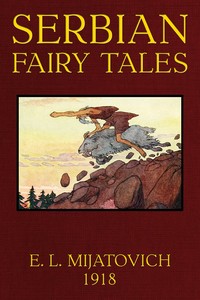
Serbian Fairy Tales — Themes and Context
(0 User reviews)
757
Project Gutenberg
2022
Not confirmed
Fairy tales -- Serbia
Readers of public-domain and historical texts
Project Gutenberg digital edition
en
Edition facts
Words
59,515
Reading time
259 min
Text sections
18
The source record for Serbian Fairy Tales — Themes and Context measures this digital text at 59,515 words, 4 hr 19 min estimated reading time, and 18 detected text sections.
The text analysis averages about 23.7 words per sentence, while the detected sections provide another way to judge how the source is divided.
Project Gutenberg metadata also associates the work with “Fairy tales -- Serbia,” connecting these edition facts with the source record’s subject description.
Source:
Project Gutenberg record #67191
This editorial note examines how the opening, middle, and later excerpts of Serbian Fairy Tales guide a first reading, focusing on the translator's voice, recurring motifs like numerical symmetry, and the blend of folkloric and comic elements.
Editorial Edition Score
4.8/5
★★★★★
★★★★★
Calculated from edition completeness, EPUB availability, text structure and catalogue metadata. Not a user rating.
How this score is calculated
- Description quality20 pts
- Title & short description10 pts
- Source metadata20 pts
- Text length15 pts
- Chapters / structure15 pts
- EPUB file integrity20 pts
Total of 100 points, scaled to a 2.5-5.0 range. Editions with an empty description or a missing EPUB file are not scored.
Edition quality
Public-domain source text
Read the source text
The source text is kept in the dedicated reader, separate from this catalogue record and its commentary.
The first tale, “The Bear’s Son,” opens with a striking premise: a bear marries a woman, and their son must prove his strength by uprooting a beech tree. The translator, Elodie Lawton Mijatovich, renders the dialogue in a direct, almost colloquial style—the Bear warns of “wicked beasts called men”—that immediately signals a folkloric register. This opening establishes a pattern of tests and thresholds that recurs throughout the collection.
A Translator’s Voice Between Oral and Literary
Mijatovich’s English retains traces of Serbian oral storytelling: repeated phrases like “Once upon a time,” formulaic exchanges, and a narrator who occasionally addresses the reader directly. In “The Biter Bit,” the priest’s wife “rushed at him with a big stick” and later “pretended that she knew nothing”—a comic doubling that the translator handles with dry understatement. The prose is plain but not flat; it carries the rhythm of a teller’s performance. Notice how the wedding preparations in that same tale accumulate specific roles—kooms, starisvats, chaious—that Mijatovich leaves untranslated, preserving cultural texture. This choice invites readers to infer meaning from context, much as listeners would in an oral setting.
Numerical Patterns and Symmetrical Structures
Several tales hinge on precise numbers: a hundred sons, a hundred daughters, two hundred bride-leaders. In “The Biter Bit,” the old man must find exactly one hundred brides for his hundred sons, and the wedding procession requires a mathematically enumerated retinue. This love of symmetry appears elsewhere—three winged horses, three-headed alligators, nine peahens. The excerpts suggest that the collection often builds plots around numerical puzzles or tests, where a character must fulfill a quota or solve a riddle involving count. Readers attuned to these patterns will notice how the stories reward patience and methodical thinking, not just brute force.
Comic Misunderstandings and Disguised Identities
The excerpt from “The Biter Bit” showcases a favorite device: characters who fail to recognize each other after a change of clothes or demeanor. The priest’s wife switches from hostile to hospitable once she learns the old man has a hundred sons, and both parties “pretended that they did not know” the truth. This motif of willful blindness recurs in other tales—a king’s son who does not recognize a transformed bride, a witch who is fooled by a disguise. The humor is gentle but pointed, often exposing greed or hypocrisy. Mijatovich’s translation preserves the comic timing through short, declarative sentences and understated dialogue.
Illustrations as Interpretive Cues
Sidney Stanley’s illustrations, listed in the contents, offer visual anchors for key moments: “Fished out a small box,” “The old witch spat on the fire,” “There appeared a great alligator with three heads.” These images, though not reproduced in the text excerpts, were clearly designed to punctuate dramatic turns. The frontispiece, showing a small box being fished out, hints at a tale where a seemingly trivial object holds narrative weight. Readers of the print edition would have encountered these illustrations as chapter breaks; in the digital version, the list of plates serves as a map of climactic scenes. Paying attention to these visual cues can help orient a first reading, especially when the tales share similar motifs.
These excerpts reveal a collection that balances wonder with wry social observation. The translator’s restraint allows the stories’ own logic—their repetitions, numerical games, and comic deceptions—to emerge clearly. A first-time reader may find it useful to note how each tale establishes its own rules early, often through a test or a bargain, and then follows them with folkloric consistency. The pleasure lies in watching the pattern unfold.
There are no reviews for this eBook.
There are no comments for this eBook.
Reader reflection
What was your reading experience?
Capture what you thought, learned, and would like to remember.
Your progress
0
/
10
2
Did this book hold your interest?
3
How likely are you to recommend this book?
4
How easy was the book to follow?
5
Did anything about the book feel genuinely new?
6
How personally connected did you feel to the book?
7
How useful did the reading feel?
8
Could you follow the author’s main argument?
9
What did this book teach you most?
10