1

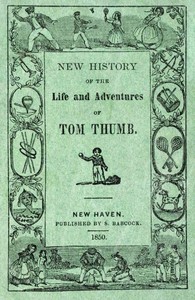
New History of the Life and Adventures of Tom Thumb — Reading Notes
(0 User reviews)
1659
Project Gutenberg
2019
Not confirmed
Fairy tales; Children's stories
Readers of public-domain and historical texts
Project Gutenberg digital edition
en
Edition facts
Words
4,637
Reading time
21 min
Text sections
1
Before opening New History of the Life and Adventures of Tom Thumb — Reading Notes, the edition data offers a quick orientation: 4,637 words, 21 min estimated reading time, and 1 detected text section.
The text analysis averages about 24.2 words per sentence, while the detected sections provide another way to judge how the source is divided.
Project Gutenberg metadata also associates the work with “Fairy tales,” connecting these edition facts with the source record’s subject description.
Source:
Project Gutenberg record #58714
This 1849 edition of Tom Thumb frames the fairy tale through a nostalgic adult narrator, contrasting past scarcity of children's books with present abundance. The text includes a verse description of Tom's miniature attire and episodes like the pudding accident, while the catalog subjects 'Fairy Tales' and 'Children's stories' align with the work's content but understate its self-aware, historical framing.
Editorial Edition Score
4.4/5
★★★★★
★★★★★
Calculated from edition completeness, EPUB availability, text structure and catalogue metadata. Not a user rating.
How this score is calculated
- Description quality20 pts
- Title & short description10 pts
- Source metadata20 pts
- Text length15 pts
- Chapters / structure15 pts
- EPUB file integrity20 pts
Total of 100 points, scaled to a 2.5-5.0 range. Editions with an empty description or a missing EPUB file are not scored.
Edition quality
Read the Text
uch amused with the idea of a boy no bigger than a man’s thumb, and sending for the queen of the fairies, he told her of the desire of the plowman’s wife. The queen was no less pleased than Merlin, and she said the wish should be granted. Accordingly, the plowman’s wife had a son, who was just the size of his father’s thumb, and was named by the queen, TOM THUMB.
One day his mother was making a pudding, and that he might see how it was made, Tom climbed on the top of the bowl; but his foot happening to slip, he fell over head and ears into it, and his mother not seeing him, she stirred him into the batter, and then popped the whole into the pot.
The hot water made Tom kick and struggle, and his mother, seeing the pudding jump up and down in the pot, thought it was bewitched. A pedlar going by at that moment, she gave him the pudding, which he put in his pack and then walked on. As soon as Tom could get the batter out of his mouth, he began to cry out. This so frightened the pedler that he flung the pudding over a fence, and took to his heels. The pudding was broken by the fall, and poor Tom crawled out and ran home.
Tom never was any bigger; but as he grew older he grew cunning and sly. When he played with boys for cherry-stones, and had lost his own, he used to creep into his playmates’ bags, fill his pockets, and come out to play again. One day, as he was doing this, the owner chanced to see him. “Ah, ha, my little Tom,” said he, “I have caught you at last; now I will punish you for stealing.” So he drew the bag-string tight about his neck, and then shaking the bag, Tom’s legs and thighs were so sadly bruised, that he was thrown into a raging fever.
Just at this time the queen of the fairies came in a coach drawn by six flying mice, and placing Tom by her side, drove through the air to her palace in fairy land, where she kept him till he was restored to health. Then, taking advantage of a fair wind, she blew him straight to the court of king Arthur. But just as Tom was about to land in the palace-yard, the king’s cook happened to pass with a huge bowl of soup, into which Tom fell plump, and splashed the hot soup all in the cook’s face and eyes.
“Oh, dear! Oh, dear!” cried Tom, half scalded and half drowned in his hot bath; “murder! murder! murder!” bellowed the cook, who was a cross, red-faced old fellow, and supposed Tom had done all this mischief on purpose. Determined to be revenged on the little fellow for the imaginary insult, he urged his brother, who was a miller, and as cross and cruel as himself, to take little Tom home with him, and put him where he could do no more mischief.
Accordingly, the miller pocketed Tom, and carrying him to his mill, dropped him from a window into the river. But Tom was not born to be drowned. A large salmon swimming by at that moment, caught him in its mouth and swallowed him without any trouble.
The salmon was soon caught, and being a fine large fish, was presented to the king, who ordered it to be dressed immediately. When it was cut open, every body was delighted to see little Tom Thumb step out. He soon became the favorite of the king, who knighted him, and gave him a little golden palace to live in, and also a tiny coach, which was drawn by six white mice.
King Arthur one day questioned Tom about his parents, and Tom informed his majesty that they were worthy people, but very poor. Then the king led him into his treasury, and showing him the piles of gold and silver, told him he might pay his parents a visit, and take with him as much money as he could carry! Accordingly, Tom procured a little purse, and putting a sixpence into it, he with much labor and difficulty got the purse upon his back and started for home.
His mother met him at the door, where he arrived almost tired to death, having traveled nearly half a mile, with a huge sixpence on his back. His parents were delighted to see him, especially as he brought such an amazing sum of money.
The 1849 edition of New History of the Life and Adventures of Tom Thumb opens not with the title character but with a framing narrator who recalls his own childhood reading. He notes that children's books were once less plentiful and cheap, and that tales like Cock Robin and Blue Beard were amusing but not very instructive. This self-conscious preface, absent from many earlier chapbook versions, positions the story as a remembered favorite rather than a straightforward marvel.
The catalog subjects—Fairy Tales and Children's stories—accurately describe the content, but the excerpts reveal a work that also comments on its own genre and history. The narrator admits the story is not true and that magicians and fairies do not exist, a disclaimer unusual for a fairy-tale publication aimed at children.
A Narrator Who Remembers
The text begins with a first-person voice: “When I was a little boy, children’s books were not quite as plenty, or as cheap, or as good as they are now.” This adult narrator explicitly addresses “my little readers,” creating a nostalgic frame that distances the tale from pure fantasy. He lists other popular stories of his youth—Cock Robin, Jack the Giant Killer, Blue Beard, The Forty Thieves—and characterizes them as “amusing but not very instructive.” This meta-commentary suggests the book is as much about the history of children’s literature as about Tom Thumb himself.
The narrator’s admission that he “knew the story was not true” and that there are “no such beings as magicians and fairies” is striking. It invites young readers to enjoy the tale while acknowledging its fictionality, a pedagogical stance that aligns with the era’s shifting attitudes toward fairy tales.
Miniature Details in Verse and Prose
Before the prose narrative begins, a four-line verse catalogues Tom’s attire: “His shirt was made of a butterfly’s wing, / His boots were made of a mouse’s skin, / His coat was wove of thistle down, / An oak-leaf hat he had for his crown.” This precise inventory of miniature objects—completed by a tailor’s needle and a mouse for a horse—establishes the story’s scale through concrete, physical details. The verse form contrasts with the surrounding prose, giving the description a memorable, almost riddling quality.
The prose episodes continue this focus on smallness. When Tom falls into a pudding bowl and is stirred into the batter, the text emphasizes his mother’s failure to see him. The pudding “jump[ing] up and down in the pot” is attributed to bewitchment, a logical misinterpretation that underscores the absurdity of Tom’s size. These details ground the fantasy in everyday domestic objects—a bowl, a pot, a pedlar’s pack—making the extraordinary seem plausible.
The Catalog Subjects and What They Miss
The Project Gutenberg record classifies this work under “Fairy Tales” and “Children’s stories,” with a secondary topic of “children-juvenile.” These labels are accurate but incomplete. The excerpts show a text that is as much about the act of storytelling as about the fairy tale itself. The narrator’s framing device—recalling a past when books were scarce—introduces a historical dimension absent from the catalog terms.
Moreover, the work includes a disclaimer about the unreality of magicians and fairies, which complicates its identity as a straightforward fairy tale. The catalog does not capture this self-reflexive, almost skeptical tone. Readers expecting a simple wonder tale will encounter a narrator who gently undermines the fantasy even as he recounts it. The book thus occupies a hybrid space: a children’s story that reflects on the value and truth of children’s stories.
Readers approaching this edition should attend to the tension between the narrator’s nostalgic affection and his rational disclaimers. The tale’s charm lies not only in Tom’s miniature adventures but in the adult voice that frames them. The pudding episode, the verse description, and the opening reminiscence all reward close attention to how the text balances wonder with a gentle, historical skepticism. This is a fairy tale that knows it is a fairy tale.
That rainy afternoon, the 1849 Tom Thumb felt less like a fairy tale than a quiet meditation on childhood’s fleeting textures—the pudding mishap, the tiny velvet coat. Its narrator’s gentle nostalgia lingered, and I found myself reaching for another old volume, one whose stories carried the same unhurried ache. Fairy Tales, Volume 1 (of 2) — Context and Discussion sat beside it, and I simply began reading.
There are no reviews for this eBook.
There are no comments for this eBook.
Reader reflection
Before you leave, reflect on the book
Use these questions to collect your thoughts before moving on.
Your progress
0
/
10
2
How much did you enjoy the reading experience?
3
Would you pass this book on to a friend?
4
Did the language feel accessible?
5
Would this book work well in a reading group?
6
Did this book create an emotional response?
7
Which part made the strongest impression?
8
Was the book moving at the right speed?
9
What is the main idea you are taking away?
10