1

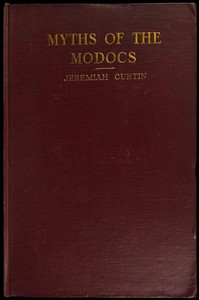
Myths of the Modocs — Reading Companion
(0 User reviews)
1042
Project Gutenberg
2024
Not confirmed
Indians of North America -- Folklore; Modoc Indians -- Folklore; Modoc mythology; Modoc Indians -- Religion
Readers of public-domain and historical texts
Project Gutenberg digital edition
en
Edition facts
Words
141,804
Reading time
617 min
Text sections
61
The catalog record for Myths of the Modocs — Reading Companion provides practical reading context through 141,804 words, 10 hr 17 min estimated reading time, and 61 detected text sections.
The text analysis averages about 13.6 words per sentence, while the detected sections provide another way to judge how the source is divided.
Project Gutenberg metadata also associates the work with “Indians of North America -- Folklore,” connecting these edition facts with the source record’s subject description.
Source:
Project Gutenberg record #73418
This editorial note examines Jeremiah Curtin's authorial choices in diction, dialogue, and description within Modoc myths, focusing on the transformation of 'first people' and the vivid speech patterns that reveal character and power dynamics.
Editorial Edition Score
4.9/5
★★★★★
★★★★★
Calculated from edition completeness, EPUB availability, text structure and catalogue metadata. Not a user rating.
How this score is calculated
- Description quality20 pts
- Title & short description10 pts
- Source metadata20 pts
- Text length15 pts
- Chapters / structure15 pts
- EPUB file integrity20 pts
Total of 100 points, scaled to a 2.5-5.0 range. Editions with an empty description or a missing EPUB file are not scored.
Edition quality
Read the Text
efore leaving the house, Kumush had said to Isis’ wives: “I am going for wood.” When he came back, the women thought he was Isis. When he asked: “Where is Kumush?” they said: “He went for wood and hasn’t come back.”
Kumush hurried the sun down and right away it was dark. All the women except Wálwilegas, Kols, Tcíkas and Tókwa thought he was Isis.
The next morning Tcíkas asked Wálwilegas what she thought.
“He isn’t Isis,” said Wálwilegas.
“That is what I think,” said Tcíkas.
Kols cried and tears ran down her cheeks. “Tears,” said she, “are a sign that Isis is in trouble.”
“What are you talking about?” asked Kumush. “Hurry up and get me something to eat. I don’t want people to come here to gamble; we will go where they are.”
After Kumush had eaten enough, he and all the women, except Wálwilegas, Kols and Tcíkas, started for Pitcowa, the place where Isis always went to gamble. (A broad flat northeast of Tula Lake.)
As Kumush traveled, he set fire to the grass; the smoke went crooked. People saw it, and said: “That is not Isis. Isis’ smoke always goes straight up to the sky.”
Kumush knew their thoughts. He tried to make the smoke go straight; part went straight and part went crooked.
Then they said: “Maybe that is Isis.”
When he got near, the people asked: “Where is Kumush?”
“He stayed at home; he didn’t want to come.”
Some thought: “This man doesn’t look just like Isis,” but they began to gamble with him.
When all the women had gone except Wálwilegas and Tcíkas and Kols, Kols began to track her husband. Wálwilegas followed her. Tcíkas put her baby on her back and started for Pitcowa. She felt lonesome. She traveled slowly, digging roots as she went along.
Kols tracked Isis to the tree. Then she said: “He is up in this tree, but he must be dead.”
“He is alive,” said Wálwilegas. “I hear him breathe. He loved his other wives and didn’t care for us. They have gone off with another man; now he will find out who loves him.”
Kols tried to dig the tree up, but couldn’t; then Wálwilegas began to make a basket. When the basket was ready, Kols strapped it on her back and flew up part way to try it. She came back, got something for Isis to eat and bear’s fat to rub him with, then she started again. She flew in circles around the tree, camped one night and reached Isis the next night. He was almost dead. She gave him seeds and rubbed him with bear’s fat. The next morning she put him in the basket and started down; she got home at midday.
Kols and Wálwilegas fed Isis well. Every night they rubbed him with bear’s fat and soon he was well again. Then they fixed a sweat-house and he sweated till his skin was nice and soft. It became rough while he was on the tree. After he had sweated, they put nice clothes on him.
Isis asked: “How did Tókwa and Nada and the others act while I was lost?”
“They didn’t care much,” said Kols; “they were not sorry.”
When the people at Pitcowa had gambled long enough, they began to play ball. Some thought that the man they were playing with was Isis; others thought he was Kumush.
Kumush had the disk on his back. It looked like a great scar. One day, while the people were disputing, some saying that he was Isis, others that he was Kumush, a man hired a doctor to make the south wind blow. When Kumush ran north after the ball and stooped down to pick it up, the wind raised his blanket and everybody saw the scar. Then they knew Kumush. They shouted, whooped and laughed. They stopped the game and gathered around him.
After Isis had sweated, he said: “We will go and see what Kumush is doing.” He went ahead of Kols and Wálwilegas, and as he traveled he set fire to the grass. The smoke went straight up to the sky. People saw the smoke, and said: “That is Isis! Isis is coming now!” Kumush saw the smoke and was scared; he trembled and almost lost his mind.
Tcíkas had been camping and digging roots. She was mourning for Isis. The child saw Isis coming and called out “Tsutowas” (father).
“Don’t call your father,” said Tcíkas, “your father is dead.”
The boy called again, and again. Tcíkas shook him and scolded him.
Jeremiah Curtin's Myths of the Modocs presents a collection of oral narratives transcribed with a distinctive attention to the spoken word. The text is marked by direct, unadorned dialogue that conveys character and conflict through repetition and simple phrasing. For instance, when Wámanik declares, 'I can be a great many different things. I am a spirit of this earth,' the syntax mirrors the cadence of oral storytelling. Curtin's editorial hand is light, preserving the repetitive structures and abrupt shifts that are hallmarks of traditional narration. The myths are populated by beings who shift between human and animal forms, and Curtin's descriptions emphasize this fluidity through matter-of-fact statements like 'He turned to a snake again.' Such choices foreground the Modoc worldview without imposing external literary conventions.
Dialogue as a Window to Power
Curtin's rendering of dialogue often reveals the social hierarchies and supernatural abilities of characters. When Tusasás boasts, 'I am stronger than Wámanik. I am not afraid of him,' the threat is immediately undercut by Wámanik's response: he makes Tusasás 'itch till he scratched the skin and flesh off from his body.' The dialogue is terse, with characters speaking in short, declarative sentences. Wámanik's commands, such as 'Go and tell Tusasás to stop making fun of my wives,' are delivered without embellishment, reflecting his authority. The speech of the old woman Wískäk is similarly direct: 'My girls are tired of digging roots, I want to dig sometimes.' This plainness contrasts with the mythic events, grounding the supernatural in everyday concerns. Curtin's transcription preserves the oral rhythm, where repetition—'I like you and I want you to like me'—reinforces emotional appeals.
Descriptive Economy in Transformation
Curtin describes shape-shifting with remarkable economy, often in a single sentence: 'He turned to a snake again, for he saw the old woman and her daughter coming.' There is no elaborate metaphor or psychological explanation. The transformations are presented as natural occurrences within the narrative logic. Similarly, Wámanik's brightness is stated without hyperbole: 'He was bright like the sun, and both his wives were bright.' This restraint extends to the depiction of the 'first people,' who are introduced through a striking simile: 'so numerous that if a count could be made of all the stars in the sky... they would not be as numerous.' Curtin lets the image stand alone, trusting the reader to grasp its scale. The descriptions of setting are equally sparse, with phrases like 'the valley of Lost River' and 'the lava beds' serving as anchors rather than elaborate backdrops.
Repetition and Oral Structure
The myths are structured around repeated patterns that reflect their oral origins. Curtin retains formulaic openings and closings, such as 'Wámanik said to Kéwe: “Go and tell Tusasás...”' which echo the call-and-response of live narration. Actions are often described in parallel: 'Every night after that the girls changed. If a person saw them one day they didn’t know them the next.' This repetition builds a rhythmic expectation. The narrative also employs incremental repetition, where a message is delivered multiple times with slight variations, as when the man is sent twice to invite Wískäk's brother. Curtin's decision to preserve these repetitions gives the text a ceremonial quality, emphasizing the communal nature of the stories. The dialogue often circles back to key themes—jealousy, hunger, kinship—reinforcing the moral and social lessons embedded in the myths.
Voice and Characterization Through Speech
Curtin distinguishes characters primarily through their speech patterns. Wámanik speaks with authority and reassurance: 'I have no people; I belong to the Earth. I live under the mountains and under the water.' His words are measured and explanatory. In contrast, Tusasás is boastful and reckless, his dialogue marked by bravado. The old woman Wískäk's speech is plaintive and concerned: 'My kin hate us.' The younger sister's voice is quieter, more receptive. Curtin does not add descriptive tags like 'he said angrily'; the tone is conveyed through the words themselves. This technique aligns with oral tradition, where the performer's inflection would carry meaning. The result is a text that feels immediate and performative, inviting readers to imagine the cadence of the original tellers. Curtin's editorial choices thus foreground the Modoc voices, allowing their distinct personalities to emerge through what they say and how they say it.
Readers approaching Myths of the Modocs should attend to the rhythms of the dialogue and the spareness of the descriptions. Curtin's transcription preserves the oral texture of these narratives, where repetition and direct speech carry the weight of meaning. The myths are best read aloud, allowing the patterns of the language to resonate. This edition offers a window into a worldview where the boundaries between human, animal, and spirit are fluid, and where power is asserted through words as much as through actions.
Reading Curtin’s notes on the Modoc voices, I recalled sitting on my grandmother’s porch, hearing her tell our family’s stories in that same deliberate, shifting cadence. Her pauses held more weight than the words. Custom and Myth New Edition — Reading Companion gave me that same quiet ache, a reminder that how we speak carries the true myth, not just what we say.
There are no reviews for this eBook.
There are no comments for this eBook.
Reader reflection
What was your reading experience?
Capture what you thought, learned, and would like to remember.
Your progress
0
/
10
2
What was your overall reaction to the book?
3
Would you recommend this book to another reader?
4
How demanding did the text feel?
5
Would you read this book again?
6
Was the book easy to understand?
7
Did the book offer a fresh perspective?
8
How strongly did the book affect you emotionally?
9
What did this book teach you most?
10