1

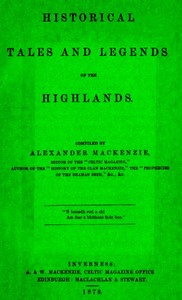
Historical Tales and Legends of the Highlands — Context and Discussion
(0 User reviews)
351
Project Gutenberg
2018
Not confirmed
Legends -- Scotland -- Highlands
Readers of public-domain and historical texts
Project Gutenberg digital edition
en
Edition facts
Words
67,539
Reading time
294 min
Text sections
25
The catalog record for Historical Tales and Legends of the Highlands — Context and Discussion provides practical reading context through 67,539 words, 4 hr 54 min estimated reading time, and 25 detected text sections.
The text analysis averages about 29.9 words per sentence, while the detected sections provide another way to judge how the source is divided.
Project Gutenberg metadata also associates the work with “Legends -- Scotland -- Highlands,” connecting these edition facts with the source record’s subject description.
Source:
Project Gutenberg record #58578
Alexander Mackenzie's 1878 compilation of Highland folklore, originally serialized in the Celtic Magazine, features tales of clan chiefs, supernatural encounters, and historical figures like Prince Charlie, with a preface noting anonymous contributors.
Editorial Edition Score
4.8/5
★★★★★
★★★★★
Calculated from edition completeness, EPUB availability, text structure and catalogue metadata. Not a user rating.
How this score is calculated
- Description quality20 pts
- Title & short description10 pts
- Source metadata20 pts
- Text length15 pts
- Chapters / structure15 pts
- EPUB file integrity20 pts
Total of 100 points, scaled to a 2.5-5.0 range. Editions with an empty description or a missing EPUB file are not scored.
Edition quality
Public-domain source text
Read the source text
The source text is kept in the dedicated reader, separate from this catalogue record and its commentary.
Alexander Mackenzie's 1878 collection, originally serialized in the Celtic Magazine, opens with a striking portrait of a West Coast township utterly isolated—without steamers, railways, or roads—where inhabitants grow their own corn, produce their own wool, and rely on a single merchant who carries tobacco and tea on his back once a month. This setting grounds the twenty-five tales that follow in a world of self-sufficiency and oral tradition. The preface reveals that most stories were contributed by anonymous writers, including the pseudonymous "Norman" and "Torquil," whose identities Mackenzie protects at their request. The compiler himself takes responsibility for the merits of his own contributions, leaving the rest to "the tender mercies of an indulgent public."
Voices of the Clans: Anonymous Contributors and Editorial Discretion
Mackenzie's preface is unusually candid about the collaborative nature of the volume. He thanks "Mac Iain" and others who supplied tales, but notes that one contributor—responsible for the majority of the stories—objects to having his name made public. This decision to preserve anonymity shapes the reader's experience: the tales carry no single authorial voice, but rather a collective clan perspective. The compiler positions himself as a conduit, not a creator, for many of the narratives. This editorial choice reflects the communal ownership of Highland legends, where stories belong to the people rather than to individual authors. The result is a text that feels less like a polished literary work and more like a transcribed oral tradition, with all the raw energy and occasional unevenness that implies.
The Weight of Guilt: A Chief's Psychological Descent
One excerpt traces a chief's torment after imprisoning a clansman for a "venal crime." The narrative shifts from external action to internal anguish: the chief hears a sullen voice whispering that his punishment is too severe, and he cannot fight victoriously under "such a load of guilt." As he prepares for battle against a numerically superior enemy, his thoughts remain fixed on the captive. The prose heightens this tension through vivid similes—he will not "bleed like the bleating lamb" but will "tear the flesh from the bones of his oppressor." Yet the chief's attempt to release the prisoner backfires when the stone door traps him inside the vault. The passage then blurs reality and hallucination: he hears (or thinks he hears) his clansmen accusing him of cowardice, the din of battle, and the triumphant shouts of his foes. This psychological layering, with its repeated "heard (or thought he heard)," suggests a mind unraveling under the weight of its own actions.
Patterns of Conflict: The Stakes of Clan Warfare
The excerpted battle scene reveals recurring motifs in Highland conflict narratives. The enemy is described as "ruthless and relentless," fighting not for honour but for "the devilish pleasure" of destroying what others built. This characterization frames the struggle as existential: defeat means "certain destruction." The chief's desperation is palpable—he determines to "hazard a battle" as his only chance, and his warriors burn for distinction. Yet the narrative undercuts martial glory with the chief's private guilt. The vault becomes a symbolic tomb, and the sounds of war reach him only as echoes. This pattern—where personal transgression undermines collective strength—appears elsewhere in the collection, as suggested by titles like "The Spell of Cadboll" and "The Fairies and Donald Duaghal Mackay." The tales consistently intertwine supernatural elements, moral failings, and violent outcomes, creating a world where honour and consequence are inseparable.
Readers approaching this collection should attend to the gaps between tales: the shift from supernatural legends to historical figures like Prince Charlie and James Macpherson, the freebooter musician. The anonymous authorship invites speculation about whose voices are preserved and whose are suppressed. Mackenzie's editorial hand is light, allowing the stories to retain their oral cadences and abrupt transitions. For those interested in the intersection of folklore, clan history, and 19th-century collecting practices, this volume offers a rich, if deliberately opaque, archive.
My grandfather used to tell me about the mist rolling off Loch Ness, the way clan names felt like weather. This book brought that back—those anonymous voices, half-legend, half-lament. It reminded me of reading The Aeneid — A Reader’s Guide last winter, that same ache of listening to ghosts, of knowing the story is already over before you arrive.
There are no reviews for this eBook.
There are no comments for this eBook.
Reader reflection
Record your reading impressions
A brief reflection can help important ideas stay with you longer.
Your progress
0
/
10
2
Did this book hold your interest?
3
Would you recommend this book to another reader?
4
How easy was the book to follow?
5
How clear did the writing feel?
6
Did the book give you something worth debating?
7
Did the book meet your expectations?
8
Could you see yourself revisiting this book?
9
In one sentence, what did you learn?
10