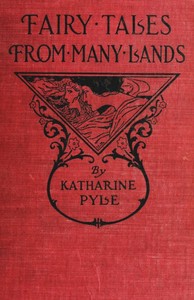
Fairy Tales from Many Lands
Edition facts
Katharine Pyle's Fairy Tales from Many Lands (1911) opens with a king who loves a golden apple tree "as though it had been his daughter," a phrase that immediately establishes the collection's blend of formal, almost biblical cadence and domestic intimacy. The tree's apples vanish each night despite guards, setting up a pattern of enchanted theft that recurs across the sixteen tales. Pyle's narrative voice shifts between measured exposition—"The king consented to this, so that evening the prince took his sword"—and sudden, sensory bursts: a sound of wings that makes eyelids "weigh like lead." This oscillation between stately pacing and abrupt, dreamlike interruption is a hallmark of the collection, one that rewards attention to how Pyle controls tempo within individual stories.
The Weight of Sleep and the Rhythm of Enchantment
In "The Seven Golden Peahens," the eldest prince falls asleep not from exhaustion but from a sound of wings that makes his eyelids "weigh like lead." Pyle uses sleep not as a passive gap but as an active, almost magical force—a recurring device that punctuates the narratives with sudden stillness. The same drowsiness recurs in "Mishosha, the Magician of the Lake" and "The Beautiful Maria di Legno," where characters are overcome at critical moments. These sleeps are never explained; they function as structural pauses, shifting the story's pace from forward motion to suspended time. The reader becomes attuned to these lulls, knowing they precede a reversal or loss. Pyle's phrasing—"he fell into a deep sleep"—is deceptively simple, but its repetition across tales creates a rhythm that feels incantatory, as if the stories themselves are governed by a spell of intermittent oblivion.
Voice and the Shifting Register of Speech
Pyle's narratorial voice is not uniform. In "The Two Sisters," the prose is brisk and almost reportorial: "She quickly hid her shining dress and shut herself in the figure." In "The Feather of the Zhar Bird," it becomes more ornate, with longer sentences and embedded clauses. This variation in register is most noticeable in dialogue. Characters speak in a formal, slightly archaic English—"My father, allow me to keep watch"—but Pyle occasionally inserts colloquial turns: "That is a brave boast for you to make." The queen mother's rebuke to laughing attendants—"These old women often know remedies that are unknown to the doctors"—has a conversational ease that contrasts with the surrounding courtly speech. These shifts in voice are not random; they often mark moments of tension or revelation, as when Maria, disguised as an old woman, speaks with deliberate gravity to hide her true identity. The reader can track character and mood through these tonal changes.
Objects as Pacemakers: Rings, Cakes, and Pearls
Pyle uses physical objects to control narrative tempo. In "The Beautiful Maria di Legno," a necklace of pearls is broken to delay pursuers: "When the guards saw the pearls rolling this way and that beneath their feet they could not resist stooping to pick them up." The action slows to a crawl as the guards scramble, buying Maria time. Later, a cake containing a magic ring becomes the vehicle for recognition—but only if eaten whole, a condition that creates suspense. These objects are not mere props; they are pacemakers, introducing pauses or accelerations. A golden apple tree, a feather, a pair of shoes—each carries a weight that alters the story's forward motion. Pyle often describes the handling of these items with precise, tactile detail: "She lifted the heavy pitcher for her to drink." This attention to the physical heft of things grounds the fantastical in a world of weight and resistance, making the sudden shifts in pace feel earned rather than arbitrary.
Reading Fairy Tales from Many Lands with an ear for pace and voice reveals a collection more varied than its uniform title suggests. Pyle does not simply retell; she modulates tone and tempo from tale to tale, sometimes within a single paragraph. Pay attention to where she slows down—a description of a dress, a moment of hesitation—and where she rushes forward. These choices are the fingerprints of a writer who understood that a fairy tale's power lies not only in its plot but in the rhythm of its telling.